
Key Takeaways
- PP duct price is an output of specification, duty and delivery terms, not a catalog figure. Fix diameter, wall thickness and grade first, and quotations become comparable.
- Material quantity is arithmetic, not a trade secret. Geometry times density gives 3.54 kg/m at φ315 mm, so you can check a material take-off yourself.
- Wall thickness scales material almost linearly. Moving from 4 mm to 5 mm adds roughly a quarter more compound per metre.
- A smaller diameter saves material but raises velocity and fan energy. ACGIH frames the trade-off as an annual-cost optimum, not a rule.
- Quotations compare only when six conditions match. A complete field set is what turns a range into a firm answer.
Two quotations for the same nominal duct diameter rarely show the same number, and neither of them is wrong. PP duct price is a function of specification, duty and delivery terms rather than a fixed catalog figure, which is why a quote for one project says little about the next one. The common mistake is treating a quotation as a market rate to negotiate downward, when most of that number was set before the enquiry was sent, by the diameter, wall thickness, material grade, fittings count, batch size, inspection scope and delivery conditions that were specified or left open.
This page covers the cost structure of polypropylene air duct and the enquiry field map that produces a usable quotation. It does not publish prices, rate tables or cost ranges, and it does not cover cross-border freight, duties, minimum order quantities or transit times, which belong to the import cycle. What it gives you is a material take-off you can calculate yourself, a method for reading the five blocks inside a quotation, and the field set that decides how accurately a supplier can answer.
A quotation is the output of a specification, not a catalogue entry, so the same nominal diameter can legitimately arrive at two markedly different figures. Polypropylene duct cost breaks into material quantity, fabrication, fittings and supports, inspection and documents, and delivery conditions; the first of those is pure geometry that any buyer can reproduce from a drawing.
What Determines PP Duct Price: The Cost Variables Buyers Actually Control
The Direct Answer: What Determines PP Duct Price
A polypropylene duct is a thermoplastic air-duct system built from extruded or moulded sections joined by flanges, sockets or hot-air welding, so its price follows seven variables. Diameter, wall thickness, material grade, connection method, fitting count, batch size, inspection scope and delivery terms each move the total. Polypropylene duct cost is an engineering output, so one nominal diameter can produce two different quotations.
Your first useful move is sorting what you control from what the duty has already fixed. Material grade is locked by the medium and the temperature the process runs at, not by preference. Diameter, thickness and connection method stay design choices, while batch size, inspection scope and delivery terms are levers you adjust without redesigning anything.
The Seven PP Duct Cost Factors and Who Controls Each
PP duct cost factors are decided by duty first and negotiating position second. Material grade answers the medium and the temperature band, so service inside −15 to +80 °C and across pH 1–14 decides whether a standard or flame-retardant compound suits. Wall thickness stays a buyer-controlled input once static pressure, the pressure a fan must overcome, is known.
Negative static pressure is what pushes a shell toward a heavier wall or external reinforcement. Diameter and connection method settle how much material and how many joints a run consumes, and flanges at 2 per 3 m section are counted per joint. A duct section is one factory-made length, and a flange is the rigid ring that bolts two sections together, so its gasket, closed-cell sponge rubber at 5 mm or thicker, follows the flange schedule rather than the duct length. Elbows, tees, reducers, dampers and expansion joints each add their own fabrication.
Why a Standard PP Duct Price List Cannot Exist
A PP duct quotation is a function of duty rather than a catalogue lookup, so a published list of rates would be wrong as soon as one input changed. Swap the medium, step the temperature, raise the vacuum, add thickness, double the fitting count or move the delivery terms, and you describe a different job. This page supplies the method and the field set instead of rates, since a method survives the next enquiry.
The catalogue round duct family runs from φ20 to 500 mm, while injection moulding reaches 600 mm on the larger shells with plate welding and flanged reinforcement. Reference section lengths run to 4 m in the smaller sizes and 3 m in the larger ones, and the length supplied moves both material quantity and joint count. The polypropylene round duct range lists the sizes behind those figures.
What you keep from this section is the split between the variables you can still change and the ones your duty has frozen. That split decides which quotation lines you can move yourself and which ones go back to the process engineer, and it is worth settling before the enquiry goes out. The full PP duct buying sequence picks up the enquiry, quotation and approval cycle that follows.
How to Estimate Material Quantity and Duct Price Per Meter Without a Price List
A material take-off is the quantity calculation that turns a duct drawing into kilograms, square metres and joint counts. Nominal diameter is the size a duct is ordered by, while wall thickness is a separate input the drawing fixes. Take a φ315 mm outside diameter, a 4 mm wall as an example input, a 3 m section, 40 sections and a density of 905 kg/m³.
Material Quantity Worked Example: φ315 mm, 4 mm, 3 m Sections
Start from a hollow cylinder, and treat φ315 mm as the outside diameter rather than a nominal bore, because the steel-trade habit of calling a duct by its bore overstates the wall. At a 157.5 mm outside radius, a 153.5 mm inside radius and a density of 905 kg/m³, the annular wall area is 3.1416 × (157.5² − 153.5²), which is 3,853 mm² or 0.003853 m². Multiplied by the density that gives 3.54 kg per metre, so a 3 m section carries 10.62 kg and 40 sections carry 425 kg of compound. The outer surface works out at 3.1416 × 0.323 m × 3 m, which is 3.04 m² per section and 122 m² across the run.
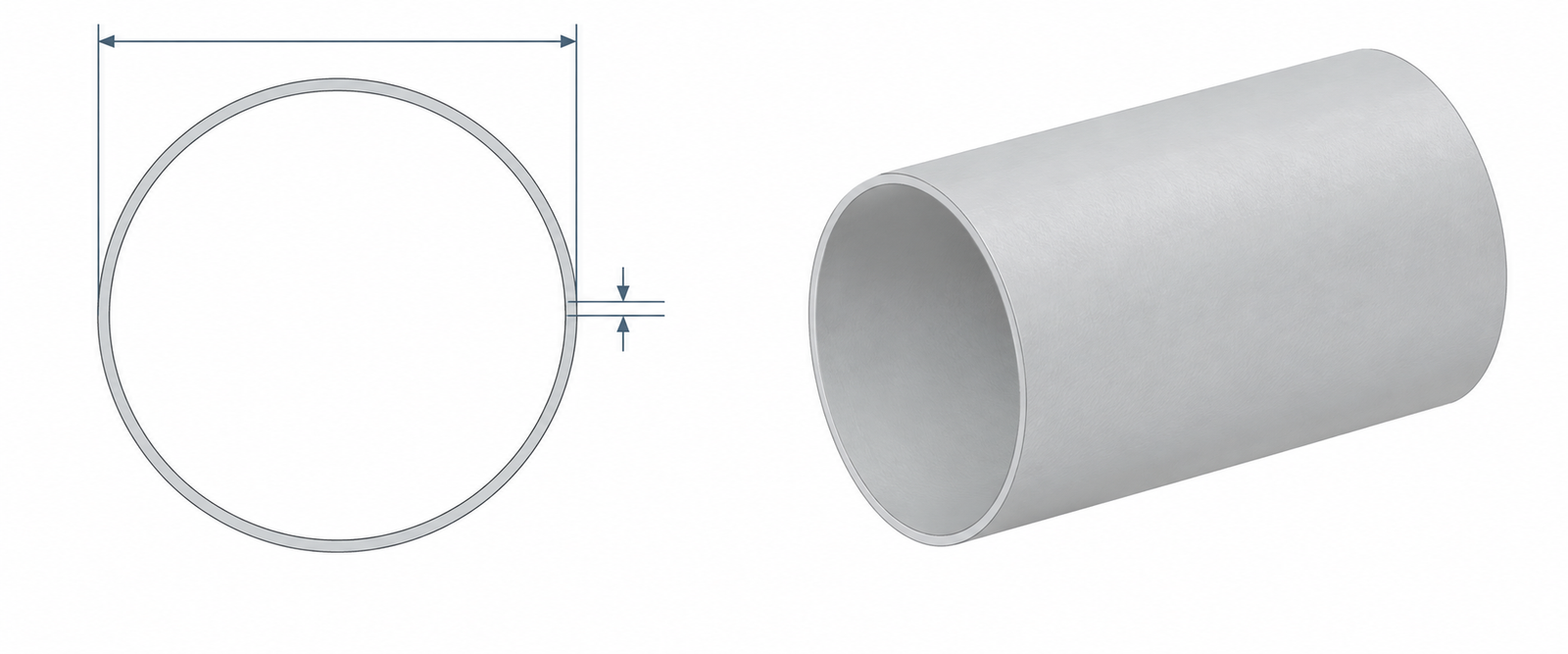
The figure is conceptual, not to scale, and the 4 mm wall and 905 kg/m³ density are sample inputs rather than catalogue values. Use the thickness on your drawing and the density declared for your grade, since a datasheet stating 0.90–0.91 g/cm³ moves the kilogram figure by about one percent.
Four quantities leave that take-off: 425 kg of compound, 122 m² of outer surface, 120 m of run at 3 m per section, and 80 flange joints at 2 flanges every 3 m. The flange ring at both ends of a section is a construction feature, not a pressure rating. The resin block inside a quotation absorbs the 425 kg, fabrication follows thickness and section length, fittings and supports follow the 80 joints, inspection follows surface area, and delivery terms follow mass and packed volume. Read those four numbers as a check on whether a quotation describes the right material quantity, with your own unit price carrying the money.
How the Result Changes When Diameter, Thickness or Quantity Moves
Mass follows the square of the diameter at fixed wall thickness. At the same 4 mm wall, a 500 mm outside diameter gives about 5.6 kg per metre, roughly one and a half times the 315 mm figure.
Wall thickness is the easiest lever to over-apply because the response is nearly linear. A 5 mm wall on the same 315 mm outside diameter gives about 4.4 kg per metre and leaves the 80 joints untouched, so one extra millimetre adds roughly a quarter more compound. Where static pressure or vacuum duty set the thickness, strength justifies the extra wall, and how wall thickness is selected in the first place covers when reinforcement is cheaper, alongside the extrusion route behind these sections.
Quantity changes the total, not the rate structure. Cutting the batch from 40 sections to 10 leaves the 3.54 kg per metre identical while total mass falls to 106 kg. Setup, documentation and inspection spread across the ordered metres, so a thin batch carries a heavier fixed share per metre, while a larger order lowers that share and leaves the compound untouched.
Unit Conversions and the Per-Meter Trap
Conversion decides whether a duct price per meter is comparable at all. Use 1 in = 25.4 mm and 1 m = 3.281 ft, so φ315 mm becomes about 12.4 in and a 3 m section about 9.84 ft. Velocity follows the same rule at 1 fpm = 0.00508 m/s, which places the ACGIH §5.18 range of 1000 to 4000 fpm inside the 5.1 to 20.3 m/s band that Table 3-2 frames as the annual-cost optimum.
The trap is quoting a rate against a diameter alone, because a metre of duct is never one quantity. Two suppliers can name the same φ315 mm and mean a 3 mm and a 5 mm wall, which differ by roughly half again in compound per metre. A per-metre rate also shifts with section length, since joints and fixed work spread across fewer metres, and a rate per kilogram, per metre or per square metre ranks suppliers differently on one job. Carry mass, surface area, joint count and section length together, apply your unit price to those four numbers, and you can estimate what a metre of your run should contain.
What Wall Thickness and Material Grade Change About PP Duct Costs
Thickness Scales Material Quantity Almost Linearly
Wall thickness is the wall dimension of the duct, measured in millimetres on the drawing. PP duct is a thin-walled shell, so wall mass grows almost linearly with thickness. Outer diameter stays φ315 mm on a density of 905 kg/m³, so a 4 mm wall gives about 3.54 kg/m and a 5 mm wall gives about 4.40 kg/m. An extra millimetre adds roughly a quarter, about 25%, more compound per metre.
Thickness raises the material and fabrication blocks together. Extrusion speed, welding time, flange rings and reinforcement all move with the wall, so the processing side does not scale as cleanly as the mass side. Two suppliers naming the same φ315 mm and quoting different walls describe different material quantities and different fabrication hours, which is why one nominal diameter reaches you as two different quotations.
| Specification change | Material quantity | Fabrication side | Buyer control |
|---|---|---|---|
| Wall thickness 4 mm to 5 mm | Up roughly a quarter per metre | Slower extrusion, more welding, heavier flanges | Fully controllable, fix it on the drawing |
| Standard grade to flame-retardant grade | Unchanged for the same geometry | Different compound cost and process window | Controllable within the duty limits |
| External reinforcement instead of extra thickness | Small, local addition | Added rings, supports and fitting work | Controllable, decided with the designer |
Grade, Flame Retardant Additives and What They Do Not Buy
A flame-retardant grade is a polypropylene compound carrying additives that suppress ignition and slow flame spread across the surface. Moving from standard to flame-retardant grade changes the raw compound and the processing window, so the material and fabrication blocks both shift, while the geometry behind the material quantity does not move. The same wall calculation returns the same kilograms per metre on either grade. Grade answers the medium, the temperature and any fire requirement the process imposes, so the duty fixes the choice before the enquiry leaves your desk. We claim no flame-retardant listing, grade number or price ratio.
The station holds ISO 9001 and ISO 14001, and the material test evidence behind these grades comes from SGS report GZMR260601945804, which reports the compound at a 0.5% shrinkage rate and 16 MPa internal pressure resistance. Both figures are material-level results from the compound, not duct working pressure, not a pressure rating and not a design pressure, and neither may be used to select wall thickness or a pressure class. Track grade as its own quotation line, and ask for the material test evidence behind these grades for the grade you specify. A line that says flame retardant without naming the report leaves the grade unverifiable, and an unverifiable grade defaults to the standard compound in every comparison that follows.
Negative Pressure, Stiffness and Why Thicker Is Not Automatically Safer
Negative pressure is an internal pressure below the surrounding atmosphere, produced when a fan pulls air out of the run. The shell then carries external compression, the load that drives thickness and external or flange reinforcement. A stronger vacuum, a longer unsupported span and a larger diameter all push the specification toward a heavier wall or added reinforcement. Thickness answers rigidity and resistance to collapse, and the grade must suit service between −15 and +80 °C.
Thicker is not automatically safer, because thickness answers one load path only. The medium, the temperature it carries, the flange sealing and the support spacing sit outside the wall, and a heavy wall on a badly sealed joint still leaks. Extra thickness against external reinforcement is an engineering decision for the design or process side, and how wall thickness is selected in the first place covers that method. Thickness and grade determine which material and fabrication blocks a quotation describes.
Diameter and Velocity: The Cost Trade-Off ACGIH Frames
Air velocity is the speed at which air travels inside the duct, and at a fixed airflow it sets the diameter. Velocity = airflow ÷ cross-sectional area, where airflow is the volumetric rate the fan moves and cross-sectional area is the internal bore that air passes through. Cut that bore and velocity rises with the inverse of diameter squared. ACGIH frames the resulting choice as a cost question.
| Air velocity (ACGIH) | Equivalent | Meaning in the manual |
|---|---|---|
| 1000 fpm | 5.1 m/s | Axial-fan preference, lower end |
| 1500 fpm | 7.6 m/s | Axial-fan preference, upper end |
| 2000 fpm | 10.2 m/s | Economic optimum, lower boundary |
| 2500 fpm | 12.7 m/s | Near-minimum annual cost band |
| 3000 fpm | 15.2 m/s | Same band, upper end |
| 4000 fpm | 20.3 m/s | Economic optimum, upper boundary |
Each tier is a cost argument in the manual, not a product limit of ours.
Why a Smaller Duct Is Not a Cheaper Duct
A narrower diameter reduces compound and raises running cost, so the lighter duct section is not the cheaper installation. Reducing φ500 mm at 5.6 kg/m to φ315 mm at 3.54 kg/m removes about 37 percent of material per metre and lifts the velocity ratio to about 2.5. Pressure drop is the static pressure lost to friction along a duct, and fan power follows airflow multiplied by that loss.
The mechanism is arithmetic. At constant airflow, velocity rises with the inverse of diameter squared, pressure drop rises with the square of velocity, and a 2.5 velocity ratio multiplies pressure drop by roughly 6.3, since 2.5² = 6.25. Fan power follows airflow and pressure drop together. Your energy tariff, running hours and service life convert that ratio into money, and how the installed layout affects pressure drop decides how much the fittings add.
The Economic Optimum: What ACGIH §5.18 Actually Says
ACGIH Industrial Ventilation §5.18, Optimum Economic Velocity, treats this as a cost problem, not a rule, and Table 3-2 supplies the velocities. Where gas or vapour exhaust carries no dust and faces no noise limit, the manual selects velocity for the lowest annual operating cost. Its method designs the system at an assumed velocity, estimates the installed capital of duct, fabrication and erection, then compares that with annual operating cost at the design’s pressure drop and running hours.
The manual reports that the optimum economic velocity can fall below 2000 fpm and above 4000 fpm. A long service life and long running hours pull the optimum down, while a high interest rate and a high duct cost push it up. It adds that 2500–3000 fpm usually keeps annual cost near the true optimum, and that axial fans favour 1000–1500 fpm. At 1 fpm = 0.00508 m/s, that spans 5.1 to 20.3 m/s. Table 3-2 names any desired velocity for vapours, gases and smoke, notes a usual economic optimum of 1000–2000 fpm, and sets higher transport velocities for dust, a duty outside this context.
Where the Velocity Decision Stops Being Yours
A duct quotation prices the shell, its flanges, fittings and supports inside a stated diameter, and it stops at that line. The fan, dampers, controls, make-up air and the structural load path that carries the run belong to the system, so the fan energy a velocity change creates stays outside a duct line. Ductwork sizing is one input to system design, and the designer, process engineer and EPC contractor own that design.
Carry a velocity into an enquiry and the supplier sizes sections to it, yet the supplier cannot say what the figure costs to operate. Treating lower velocity as a saving skips the fan, the controls and the support steel, which is why when another material changes the comparison belongs beside the velocity question. Fix diameter and velocity with the system designer, then compare quotations against one agreed velocity per duct run so every bid describes the same duty.
Why Quantity Changes the Unit Rate Without Changing the Spec
Fixed Setup Work That Does Not Shrink With Order Size
Set-up is the non-recurring preparation a shop performs before a duct section can be produced, counted per production run instead of per metre. Tooling alignment, die or mandrel adjustment, welding parameters and the first-article weld test happen once a run starts, whether that run yields 40 sections or 10. Scheduling carries its own fixed work, since clearing a line, staging compound and issuing route cards happen per job.
Because that work is counted per run, a shorter run spreads it across fewer metres of output. The mechanism is amortisation, the spreading of a once-only cost across the units that follow it, and a thin batch carries a higher fixed share per metre. This is an amortisation structure, not a penalty policy, so the share compresses as the run lengthens.
What Actually Scales With Your Quantity
Variable work is counted per unit, so it moves with the section and joint counts, not the run. At 3.54 kg/m the compound per metre holds at any batch size, so total mass reads 425 kg at 40 sections and 106 kg at 10. Processing hours, flange dressing and weld passes track joint count, which reaches 80 flange joints at 2 flanges every 3 m across 40 sections of 3 m.
| Cost element | Fixed per production run | Scaling with quantity |
|---|---|---|
| Set-up, tooling, parameters | Full amount on every run | No change with section count |
| Material | No fixed component | 3.54 kg/m, so mass follows section count |
| Welding and flange work | Minimal fixed share | Follows joint and section count |
| Inspection, documents, packing | Batch-level arrangement | Follows area, batch and packed volume |
Quantity therefore leaves the material content of a metre untouched. What a thin batch raises is the fixed share carried by every metre, which is a different quantity from the compound inside the wall.
How to Reduce the Penalty Without Pretending It Is a Discount
The penalty is reducible from the buyer side, because most of it comes from how many separate runs a specification forces, not the section count. Harmonise diameter and wall thickness so one set-up serves more metres, and combine parts sharing one grade so the shop does not switch compound mid-programme. Standard reference section lengths of 3 m and 4 m avoid tooling changes.
Submission quality matters as much as plan size. Give the fittings list and drawing once, complete, so a second set-up is not needed to finish a job that should have run through in one pass, and state the staged delivery plan up front, since a mid-programme specification change restarts the fixed work. This is not a discount, so a buyer treats it as consistency of its own specification and programme, not a request for a price concession, because the fixed work still has to be performed. Where the duty is fixed and you can choose which specification and programme items to align, you move the fixed share per metre yourself. Delivery terms sit on the enquiry record, and where delivery terms change the landed structure covers those. Where a run needs tolerances the shop does not hold as standard, agree them early through custom sizes and tolerances.
The Five Cost Blocks in a PP Duct Price and the Boundary of a Duct-Only Quote
Block 1 and 2: Material and Fabrication
Material is the compound inside the shell, so geometry fixes its size. A φ315 mm outside diameter with a 4 mm wall at 905 kg/m³ gives 3.54 kg/m, so 40 sections of 3 m carry 425 kg. Diameter, thickness and grade stay controllable, and how the fume chemistry fits the material settles the grade.
Fabrication is the shop work turning compound into sections, driven by the forming route, welding hours, flange reinforcement and openings. Thickness and section length stay controllable, so the 3 m and 4 m lengths change the joint count, and quotations price this line per joint.
| Cost block | What determines it | Buyer control | Quotation wording |
|---|---|---|---|
| Material | Quantity, grade | Diameter, thickness, grade | By kilogram |
| Fabrication | Forming, welding hours | Thickness, section length | Per section |
| Fittings and supports | Piece count | Fitting schedule | Per piece |
| Inspection and documents | Inspection scope | Scope on enquiry | Per report |
| Delivery terms | Responsibility split | Loading point | Stated conditions |
Fittings, Supports and Field Labour: The Second Cost Block
A fitting is a shaped component changing direction, size or flow inside a run, and an expansion joint is a flexible element absorbing movement between two fixed sections. Elbows, tees, reducers, dampers and expansion joints are counted per piece, so your fitting schedule sets the count and quotations price them per piece.
A hanger is the support carrying duct mass, and field labour is site work following joints and lifts. Flanges at 2 flanges every 3 m are a construction feature of the section, not a pressure rating, so 40 sections give 80 flange joints gasketed at 5 mm or thicker.
Cutting material does not shrink this block, because the fittings and supports follow the routing and the piece count rather than the duct mass. φ110, φ315 and φ500 mm sections run through the same schedule of elbows, tees, reducers and hangers, and how the installed layout affects what the duct quote covers sets the hanger count.
Inspection, Documents and Delivery Terms as Cost Blocks
Inspection and documentation form their own block. An inspection scope is the set of checks a buyer asks for before despatch, so certificates, a trial assembly and a test report each add work and a document. Buyers control the scope, and quotations price it as certificates or reports.
Delivery terms state who loads, who arranges carriage and where risk passes to the buyer. Buyers control this block by naming the collection or delivery point on the enquiry, and carriage across a border stays outside a duct line.
Where a Duct-Only Quote Ends and the System Begins
A duct-only quotation prices the shell, its flanges, fittings and field work inside the stated diameter, and ends at the run boundary. The fan, dampers, controls, make-up air and structural and electrical work serving the duct are system items quoted separately, so naming the boundary stops a system-side cost being read as a duct figure.
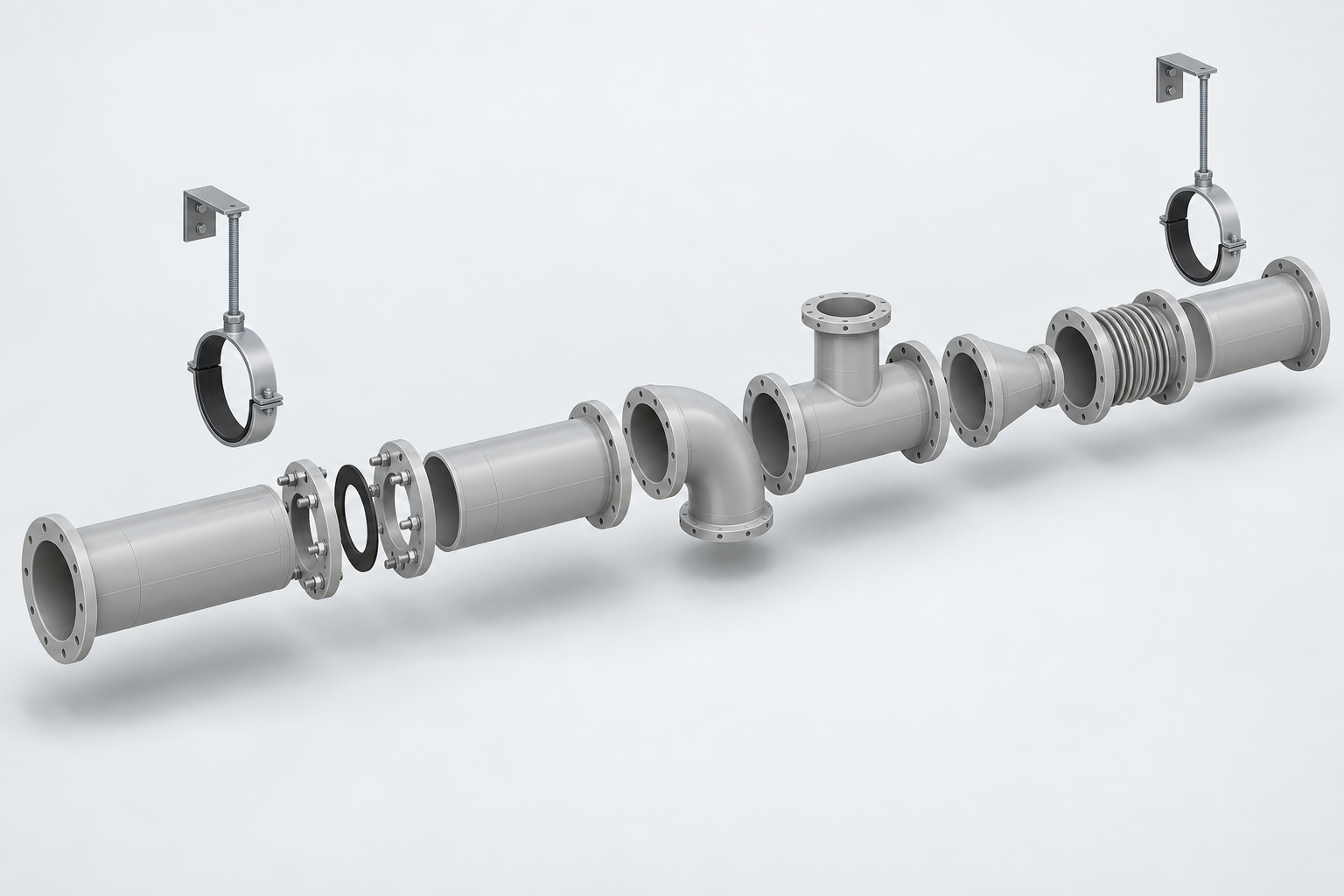
The figure shows those parts as separately priced components, so each flange joint, fitting, hanger and expansion joint is counted inside its own block. Part types are indicative, with no dimensions, wall thickness, pressure or grade marked.
State on the enquiry whether supports, field labour, inspection and delivery terms sit inside the duct package. With the five blocks anchored, pp duct cost factors read as a specification list, and you can now name the block that any quotation line belongs to.
The Life-Cycle View: When a Higher First Cost Is the Cheaper System
Life-Cycle Cost Is a Method, Not a Number
Life-cycle cost is the comparison method that weighs a first investment against the cost of owning a system afterwards, and it applies because the cheaper enquiry line is not always the cheaper run. Two duct options can meet one performance requirement while differing in capital cost, in operations, maintenance and repair cost, or OM&R, and in service lifespan. A higher purchase price earns its place only where it buys a lower future cost burden.
The comparison converts future money into today’s terms, because discounting treats a future cost as smaller than one paid now, and present value is the single figure a discounted stream collapses into. The ten-step framework in NIST Handbook 135 runs from defining the problem through listing feasible alternatives, setting common assumptions, estimating costs with their timing, discounting to present value, comparing, testing uncertainty, to a recommendation. A comparison built on first cost alone implies every future cost is zero, so the cheapest enquiry line can win on paper and lose in service.
Where Material and Fabrication Spending Buys Lower Running Cost
Material and fabrication spending can buy lower running cost, and the mechanism runs through velocity and pressure drop. A larger diameter carries a larger material mass, since φ500 mm at 5.6 kg/m outweighs φ315 mm at 3.54 kg/m, and the wider bore slows the air, which lowers pressure drop.
Fan power moves with both airflow and pressure drop, and the dependence on velocity is high-order, near cubic, so a lower velocity cuts running power faster than it cuts mass. Velocity held inside the ACGIH band of 2500–3000 fpm sits close to the optimum for most general ventilation duty, so a further diameter increase buys progressively less. Treat that band as the conversation point for the enquiry and write one agreed figure into the field set, because a duty carrying dust or a noise limit sits outside this section and goes back to the system designer for a value.
Spending more on bore returns a lower running cost only where the added joints, fittings and support steel stay small against the fan energy saved, and where the duty is expected to hold at that airflow. Where the design airflow may grow, buying the larger diameter now and enlarging later are two separate commitments, and the comparison table has to carry them on separate lines. A duty profile run against both options settles which of the two the project is actually choosing, and we can walk through that duty profile with you before the comparison is fixed.
| First-cost item | Operating and maintenance item | Uncertainty source |
|---|---|---|
| Wall thickness and grade | Repair and weld intervention | Medium and temperature change |
| Diameter and fittings | Fan energy over the duty | Load growth and added branches |
| Supports and field labour | Inspection and re-testing | Retrofit and shutdown exposure |
| Documents and delivery terms | Spare parts and rework | Lifespan difference between options |
Uncertainty You Should Carry in the Comparison
Residual uncertainty is the part of an outcome no assumption set removes, and the first such gap is load. Process expansion or an added branch can move the design airflow after the duct is ordered, so state the growth you expect and the growth you would refuse.
Medium and temperature conditions form the second gap, since pH 1–14 and −15 to +80 °C describe the duty band the selection was made against. Future change is the third, because rework on live processes carries its own shutdown cost. The framework leaves lifespan and economic parameters to the owner and its finance side, so a flag belongs in front of any comparison: flag load growth, medium exposure and shutdown exposure before signing, then re-check the chosen diameter against them.
What to State When You Ask for a PP Duct Price: The Quotation Field Map
What to State: The PP Duct Quotation Field Map
An enquiry is the field set a buyer sends so a supplier can price the described layout; an enquiry that omits fields returns an answer built on assumptions. The field map sits at the specification stage of the step-by-step buying process it sits inside.
The specification group fixes geometry, grade and joint type. Nominal sizes run across a φ20 to 500 mm catalogue family while the injection-moulding capability reaches 600 mm, so say whether your line needs a size the standard family already holds. Wall thickness is a buyer input from the drawing, and a 4 mm example input and a 5 mm one carry different mass. Grade, joint method and the 3 m or 4 m reference length close the group.
The duty group is where most enquiries stall. State the medium and its concentration inside a pH 1–14 band, then the normal condition and the peak temperature within the −15 to +80 °C range your selection was made against. Working pressure and negative pressure belong in the same message, with design airflow. Total segments or total metres lead the quantity group, followed by fittings counted by piece; the supplier confirms commercial terms against that list.
Inspection scope, with the certificates and test reports required, packaging and marking, then delivery location and who carries loading and transport complete the set.
| Field group | What it fixes | What a missing entry changes |
|---|---|---|
| Specification | Grade, thickness, joint type | The answer arrives as a range on assumed thickness |
| Duty conditions | Temperature, pressure, medium | Selection carries uncertainty and a re-confirmation |
| Quantity and fittings | Piece counts and batch plan | Fittings are estimated, then trued up in execution |
| Inspection and documents | Test scope and certificates | Inspection and documents sit outside the quoted scope |
| Delivery terms | Where the answer stops | The answer ends early on a shared-cost structure |
How Missing Fields Change the Answer You Get Back
A missing field does not return a question; it returns a different answer, and the shape of that answer tells you what the supplier had to assume. Unstated wall thickness or grade is the loudest case, because the supplier can answer with a spread or with a default, and neither fits a comparison.
Missing duty conditions shift the cost to a later stage. Where the peak temperature is absent, or pressure arrives without its temperature, selection carries uncertainty, so the supplier either re-confirms before answering or moves the number at the submittal stage. A missing fitting list leaves piece counts estimated for later truing up. An absent inspection scope leaves the work undefined.
Peak Temperature, Pressure and Negative Pressure: The Three Fields Buyers Under-Specify
Peak temperature is the field a drawing rarely carries, and the omission costs time to correct. Peak temperature is the highest medium temperature the duct will meet in service, not the average operating temperature, and this figure drives grade and wall thickness.
The second gap is a split pair. Pressure without the temperature beside it carries no usable meaning, because temperature weakens a thermoplastic and the two figures set the window a grade can hold. Put both in one line of the message.
Negative pressure is the third, and buyers most often leave it to the supplier. Negative pressure is the condition created when a fan pulls air from the duct and drives collapse resistance through a thicker wall or external stiffening. Where a layout includes a vacuum-side run, say so. All three fields sit with the process or design side, so gather them before the enquiry leaves.
State the fields before you ask for the number, then check each one against the drawing and the specification sheet. Once you can state every entry on this map and ask only for what the map cannot supply, send the field set with your layout instead of a round of follow-up questions, and talk through your field set with an engineer where an entry still has no answer.
How to Compare PP Duct Price Quotations in a Like-for-Like Grid
A like-for-like comparison is a reading in which every quotation describes the same pipe size, grade, connection method, scope and delivery responsibility, so only the description of the work differs. Different formats do not block that reading, because the grid you draw is your own.
The Six Conditions That Make Two Quotations Comparable
Six conditions decide whether two PP duct quotations describe one object or two, and they are the diameter basis, the wall thickness, the material grade, the connection method, the inspection scope and the delivery condition.
| Comparison condition | What to check on the quotation | What an unexplained mismatch means |
|---|---|---|
| Diameter basis | Whether the size is stated as outside diameter or as nominal bore | One line may describe a different pipe than the other |
| Wall thickness | The stated thickness in mm for every straight run | A 4 mm line and a 5 mm line are not the same component |
| Material grade | Standard grade against flame-retardant grade | Two grades do not share a duty envelope |
| Connection method | Flange, socket or hot-air weld, plus gasket at ≥5 mm | Joint cost and joint count sit in different work |
| Inspection and documents | Certificates and test reports inside or outside | One offer covers an undefined slice of the work |
| Delivery condition | The point where risk passes | Two offers stop at two different places |
Where any one condition differs, the two quotations are not offers for one object.
Cross-Checking a Quote Against Your Own Material Take-Off
A material take-off is the quantity list you calculate from the drawing, and it tests a quotation against geometry. Compound density for PP sits near 905 kg/m³, the figure behind every mass you derive.
Work one line of your take-off. A φ315 mm run at 4 mm wall thickness comes to 3.54 kg/m, so forty 3 m segments give 425 kg. Those segments run to about 122 m² of outside surface, and a layout with 2 flanges every 3 m carries 80 flange joints. The quotation’s description should agree with the take-off.
Keep the check inside quantity. Where a quotation describes a mass or a piece count far from your geometry, it is probably built on another wall thickness or grade, so the offer covers a different specification than the one you drew. Ask where the difference comes from. The question concerns the specification and the scope.
What to Ask When Two Comparable Quotations Still Differ
A scope is the list of work and supply one quotation includes, and a responsibility boundary is the point where a supplier’s duty ends and yours begins. When two comparable offers still differ, the cause sits in one of three places: a specification difference such as wall thickness, grade, connection method or segment length; a scope difference such as fittings and supports, field labour, inspection, documents or packaging; or a delivery condition difference such as the point where risk passes.
Put the question in writing and ask for a line-by-line confirmation. Ask which wall thickness and grade a line assumes, whether supports and field labour sit inside the scope, and at which point risk passes. Where delivery terms change the landed structure, keep that clause separate from the technical reading, and the product pages carry the round-duct structures when you need modelled geometry beside a quoted description.
Settle these three categories first, since an amount compared across unclear specifications, scope and delivery conditions carries no meaning. Once each offer is stated on the same conditions, you can select the comparable set and select the differences worth a written question.
FAQ: PP Duct Price, Per-Meter Rates and Quotation Practice
Is there a PP duct price list per meter? A per-meter price list holds only once a diameter, a wall thickness, a material grade, a joint style, a quantity and a delivery basis are all fixed. Change one input and that line stops describing the same deliverable. The method and field set on this page carry across projects; a single list does not.
How is polypropylene duct cost usually estimated? Estimation runs in three stages: specifications first, then material quantity from geometry and density, then fittings, inspection items and delivery conditions on top. The three material quantities worked through earlier in this article already reach that second stage. Estimating as far as mass, area and piece count is enough to support an enquiry and to check a reply against.
Is there a ductwork pricing calculator for industrial duct? No single formula prices industrial exhaust ductwork. Geometry is calculable, while service conditions, inspection scope and delivery terms are not formula inputs at all. Omit one input and the output carries no usable meaning.
What is the price per meter for PP duct? That question is missing three premises: whether the diameter means outer dimension, which wall thickness applies, and which material grade is specified. Supply the three and the material quantity method given earlier in this article delivers a defensible basis for a serious enquiry. Leave them open and any number offered belongs to somebody else’s assumptions.
Why do two suppliers quote different prices for the same diameter? Matching diameters do not make matching scopes of supply. Wall thickness stands among the five common sources of divergence, alongside connection method, flange arrangement, inspection and documentation scope, delivery conditions, and batch size. Treat a price comparison as meaningless until all five sit inside one specification.
Does a larger diameter always cost more? Pipe mass rises with diameter, and a wider bore holds more material per unit length. Running losses move the other way, since a wider bore can run at lower air speed and returns lower pressure drop. A total-cost optimum therefore sits between the two extremes, because velocity cannot be reduced indefinitely without losing material transport, and the ACGIH industrial ventilation guidance frames that practical band.
Does flame retardant PP duct cost more than standard grade? A flame retardant grade is a distinct compound rather than standard pipe plus an additive, and the change shifts the material block and the processing window. Wall thickness and material quantity geometry stay unchanged, so only the material and processing sides of the estimate move. No flame-retardant listing, grade number or price ratio is claimed here.
How do I prepare a request for a PP duct price that is firm? A firm quotation is a fixed figure held open for a stated validity period on a defined scope of supply, and it requires all five field groups: specification, service conditions including peak temperature and pressure or vacuum, quantity and fitting list, inspection and documentation, and delivery terms. Any single missing input turns the reply into a range, a follow-up question, or a revised figure. When a firm number matters, list those five field groups before sending anything and set aside any question form that leaves a premise open.
Conclusion: Reading PP Duct Price as a Structure, Not a Number
PP duct price behaves like an output, so no universal rate table can describe it. A quotation restates the specification, the duty and the delivery conditions fixed before you send the enquiry, and changing any one input gives a different number.
Those inputs split by who controls them. Diameter, wall thickness, material grade, joint method, batch size and schedule sit with you, while the medium, the temperature, the pressure or vacuum duty and the site conditions arrive from the process. Comparability needs its own foundation, and six conditions build it: matching diameter, matching wall thickness, matching grade, matching joint type, matching inspection and documentation scope, and matching delivery terms. Trim one of the six and you rank two different offers. The work runs in four moves: collect the field set, size the compound mass from geometry, issue the enquiry, and open the reply with the cross-check table.
Put your own take-off beside the reply, since a φ315 mm run at a 4 mm wall on 905 kg/m³ comes to 3.54 kg/m across 3 m sections, and you can assemble a cross-check sheet that names the cause of any mismatch. Bring the drawing or the duct schedule to send your duct schedule and field set and each returned line is verified against the field it answers.