
Key Takeaways
- A flame retardant duct is not defined by a label alone. In this guide,
flame retardant ductmeans a duct selected with a material-level flame claim while system-level fire evidence remains a separate check.- UL 94 classifies plastic specimens. A V-0 result does not by itself rate an installed duct assembly.
- PP, PVC and metal must be screened on six axes. Chemical duty, temperature/ignition, mechanics, joints, maintenance and system documents all matter.
- A fire-rated or smoke-control requirement changes the evidence gate. Ask for the specified assembly scope and responsible authority, not only a material grade.
- A usable RFQ names the material, thickness, geometry, duty and documents. A generic “V-0” reply leaves decision-critical fields open.
No material family wins a flame retardant duct comparison on its name alone. A flame retardant duct shortlist starts from the service envelope — gas, concentration, moisture, temperature and ignition exposure — plus the fire evidence the project requires. The common false equivalence is treating a material-level flame claim such as UL 94 as proof that the installed system is fire-rated; UL Solutions describes UL 94 as a classification of plastic specimens under controlled laboratory conditions, which is a separate question from fire-rated or smoke-control duct assemblies.
PP air duct systems, PVC and metal each enter a shortlist only under defined conditions. The same five screening inputs apply to all three families, so you can compare them on one screen instead of on marketing labels. Nothing here makes a final fire classification; the applicable code, the responsible engineer and the authority having jurisdiction do that.
Which Duct Material Should You Shortlist First?
None of the three shortlists first on name alone; you define the service conditions and the required level of fire evidence before any material vote. For a flame retardant duct, the screening starts with the process duty — gas, concentration, moisture, temperature and ignition exposure — because the same family can pass one duty and fail another. PP, PVC and metal then stay or drop out on the five initial inputs below, and every unspecified cell is a confirmation task.
| Initial screening input | PP — flame-retardant polypropylene | PVC | Metal (galvanized or stainless) |
|---|---|---|---|
| 1. Process gas and chemical duty | Confirm the quoted grade against the actual chemicals, concentrations and moisture | Confirm the quoted grade against the same exposure list | Confirm the specific alloy or coating; galvanized and stainless are not interchangeable |
| 2. Temperature and ignition exposure | Confirm operating and peak temperature and any ignition source | Confirm the same inputs for the quoted grade | Confirm the same inputs for the quoted system |
| 3. Mechanical and connection inputs | Confirm diameter, wall thickness, supports and joint type (socket, flange or specified) | Confirm the same geometry and joint details | Confirm the same geometry and joint details |
| 4. System fire/smoke requirements | Material claim is not system evidence; confirm the specified assembly scope | Same check | Same check |
| 5. Evidence and documents | Request grade, tested thickness and test scope (e.g. UL 94) | Request the same package for the quoted PVC | Request the same package for the quoted metal |
The first failure mode is not a material name but a mismatch between duty and evidence. Chemical exposure can change when vapor condenses, a connection or support can become limiting even when the duct material looks suitable, and a project fire requirement can reject all three unverified options. Write normal and credible upset conditions next to each RFQ line, then ask which document covers that line; if no document names the quoted grade, thickness, joint and assembly scope, leave the candidate as Confirm for the specified grade/system rather than converting a page claim into approval.
Keep the material layer and the system layer separate while you screen. UL Code Authority distinguishes fire-resistive and fire-protective duct assemblies as component and system contexts defined by properties such as stability, integrity and insulation, so a V-0 material claim alone cannot prove an installed duct assembly is fire-rated or smoke-control ductwork. For broader category context, use the PP air duct guide without treating it as project approval. Where a cell has no spec-grade answer, mark it Confirm for the specified grade/system and gather that document before ranking the family.
One worked reference keeps those boundaries concrete. The XICHENG flame-retardant PP ventilation pipe page lists a 500 mm class, pH 1–14 and a reference range from −15 °C to 80 °C that need project confirmation — not universal PP limits — and the page states it is not a substitute for certified fire-rated or smoke-control ductwork. For a purely illustrative first-pass screen, write down 500 mm, 10,000 m³/h, 60 °C, 300 mm, 4,000 m³/h and 40 °C as input slots only; these are scenario placeholders, not product limits. Gather the five inputs above and you have the exact fields your shortlist and your supplier RFQ both need.
Decision point: Shortlist a material only after the service conditions and the required level of fire evidence are defined.
What UL 94 Tells You About a Flame Retardant Duct Material
UL 94 Tests Plastic Specimens, Not an Installed Duct System
UL 94 is a flammability classification that measures flame behavior on a small, molded plastic specimen, not on an installed duct. UL Solutions describes the standard as a classification of plastic materials under controlled laboratory conditions and lists 12 classifications; the group commonly used for general construction and enclosure materials covers 5VA, 5VB, V-0, V-1, V-2 and HB. The specimen is conditioned, mounted in a fixed orientation and exposed to a burner flame with the sample size and flame application set by the standard.
That boundary changes how you read a supplier’s V-0 label. A classification from UL 94 does not itself prove fire-rated or smoke-control ductwork, low smoke, low toxicity, oxygen index, code compliance, or that a particular XICHENG product is certified. A duct wall in service faces ignition sources, airflow, joints and maintenance the specimen test never reproduces, so the label answers one narrow question about the material itself. Before you rank the material, ask which standard edition, which specimen and which test report support the claim, and keep the system-level fire requirement as a separate line in the RFQ.
How V-0, V-1, V-2, and HB Differ
The V classes come from a vertical burn; HB comes from a horizontal one. In the vertical test the specimen is 125 mm long × 13 mm wide, a 20 mm flame is applied twice for 10 seconds, and cotton is placed 300 mm below the specimen. V-0 limits after-flame to ≤10 seconds per application, V-1 and V-2 allow ≤30 seconds, and V-2 permits flaming drips that ignite the cotton while V-0 and V-1 do not. HB sets a horizontal burn-rate limit of ≤40 mm/min at 3–13 mm specimen thickness and ≤75 mm/min below 3 mm; RTP Company’s criteria cross-check this reading.
| Classification | Specimen orientation | After-flame limit per application | Flaming drip criterion | Buyer reading |
|---|---|---|---|---|
| V-0 | Vertical | ≤ 10 seconds | Drips must not ignite cotton | Fastest self-extinguishing of the V group |
| V-1 | Vertical | ≤ 30 seconds | Drips must not ignite cotton | Self-extinguishing, slower than V-0 |
| V-2 | Vertical | ≤ 30 seconds | Drips may ignite cotton | Self-extinguishing, but burning drips are permitted |
| HB | Horizontal | Burn rate ≤ 40 mm/min (3–13 mm) or ≤ 75 mm/min (below 3 mm) | Not a criterion | Horizontal slow-burning classification; not self-extinguishing |
Read the table as specimen response to a small, controlled flame under stated conditions, not as a duct-system fire rating. The procurement-relevant difference is the after-flame ceiling and the drip rule: if burning drips from a specimen are a risk in your installation, V-2 is a different answer than V-0, and neither says anything about smoke or toxic products of combustion. Ask the supplier which classification the quoted material carries and whether the report documents the same orientation, conditioning and specimen thickness as your quotation.
Keep every label bound to its specimen before comparing materials: a classification describes the tested bar, not your duct run. Our published UL 94 grades and criteria explains the full classification set if you need more context, but treat the standard and its test reports as the authority for a buying decision. If a supplier quotes only a V-0 label with no thickness, the claim is incomplete for a duct quotation. The next check decides whether that classification applies to what you were quoted — formulation and tested thickness.
Why Formulation and Tested Thickness Matter
A UL 94 classification belongs to one formulation at one tested thickness, and it does not transfer by resin name. A flame-retardant grade is a formulation-specific test result; the base polymer, additive package and reported specimen preparation belong to the claim. Specimens are commonly tested at thicknesses such as 0.7 mm, 1.5 mm or 3.0 mm — those are test-specimen thicknesses, not XICHENG wall specifications — and a rating at one thickness does not automatically hold at another. Conditioning also belongs to the test boundary: specimens age for 48 hours at 23 °C/50% RH, or 7 days at 70 °C for the elevated-conditioning route, before the flame is applied.
That is why the checkable document outranks the label. Ask for the Yellow Card or other test report, where applicable, that names the exact grade, the tested thickness, the classification and the standard edition, then confirm the quoted duct wall thickness falls inside that result. A “V-0 grade available” supply statement — including on XICHENG’s flame-retardant PP page — is a commitment to confirm per project, not a certification, a Yellow Card or a fixed tested thickness, and UL 94 by itself establishes neither code compliance nor system suitability. The same rule extends to the rest of the duct system: a joint, flange or support is not covered by a specimen rating.
Decision point: Accept a UL 94 claim only when the formulation, tested thickness, rating and supporting document match the material being quoted.
PP vs PVC vs Metal: Compare the Duct on Six Axes
Screen PP, PVC and metal on the same six axes and keep only the family that passes every applicable one; no family wins on name alone, and a strong result on one axis does not offset a failure on another. The axes are chemical exposure and corrosion, temperature and ignition exposure, mechanical loads, supports and impact, joining and leak control, condensation, drainage, inspection and maintenance, and the material-versus-system evidence each candidate can produce. Chemical compatibility comes first in exhaust service, which is the order Labconco’s ductwork selection guidance applies in its laboratory context; the same sequence keeps this comparison honest for industrial runs; for a broader PP duct alternatives comparison, keep the same condition-first order.
For any flame retardant duct shortlist, read the table below with a spec sheet in hand, and use this PP vs galvanized duct comparison for a separate galvanized deep dive. Each cell is conditional: where the quoted grade, thickness, joint or system document is not yet defined, the cell reads Confirm for the specified grade/system instead of a default property. Run the numbered sequence after the table, then read the four axes below for the failure mode and the confirmation action on each.
| Axis | PP — flame-retardant polypropylene | PVC | Metal (galvanized or stainless) |
|---|---|---|---|
| 1. Chemical exposure and corrosion | Confirm the quoted grade against the actual gas, concentration and moisture | Confirm the quoted grade against the same duty | Confirm the specific alloy or coating; galvanized and stainless are not interchangeable |
| 2. Temperature and ignition exposure | Confirm operating and peak temperature and any ignition source | Confirm the same inputs for the quoted grade | Confirm the same inputs; a metal duct is not automatically fire-rated |
| 3. Mechanical loads, supports and impact | Confirm diameter, wall thickness, support spacing and impact risk | Confirm the same geometry and support details | Confirm gauge, section and support layout for the load case |
| 4. Joining and leak control | Confirm joint type (socket, flange or specified) and assembly control | Confirm the jointing method for the quoted grade | Confirm weld, flange or fitting standard and joint corrosion control |
| 5. Condensation, drainage, inspection and maintenance | Confirm drainage slope, cleanout access and cleaning procedure | Confirm the same for sustained moisture duty | Confirm condensate handling and corrosion at welds and fittings |
| 6. Material and system evidence | Request grade, tested thickness and test scope; system fire/smoke evidence is separate | Request the same package for the quoted PVC | Request the same package for the quoted metal |
The XICHENG flame-retardant PP ventilation pipe page shows a 500 mm class, pH 1–14 and a reference range from −15 °C to 80 °C as product-page values that need project confirmation. Those values are not universal PP duct limits, and the page’s socket/flange options are configuration fields rather than evidence of a tested joint or complete system. Use one illustrative input pair when checking the table: 500 mm at 10,000 m³/h and 60 °C, or 300 mm at 4,000 m³/h and 40 °C; these are placeholders for the verification sequence, not product limits or material scores.
Work the table as a short selection sequence; the broader ventilation duct materials map can be used after this comparison:
1. Write the service envelope — gas, concentration, moisture, operating and peak temperature, and any ignition source — before scoring any family. 2. Fill each cell with the quoted grade’s documented answer; leave any cell without a spec-grade document as Confirm for the specified grade/system. 3. Flag every family with a failed or unanswered applicable axis. 4. Check the system-level fire or smoke requirement separately; a material claim is not that evidence.
Chemical Exposure and Corrosion
Chemical duty decides first, because the same family can pass one stream and fail another. PP can be a candidate in corrosive-duty exhaust, including the flame-retardant PP product context shown by XICHENG, but the quoted grade must be checked against the actual gas, concentration, temperature and moisture; PVC is bought the same way, on its compatibility with the specific stream; and galvanized steel is not an automatic answer for corrosive fumes — stainless or a coated option may be the only defensible choice, still tied to the specified alloy and conditions. Treat the resin name as a starting point, not an approval.
The failure mode is wet chemistry changing the exposure: condensation or dilution can alter the corrosivity a compatibility chart never covered. Confirm that the compatibility statement covers the actual gas list, the highest operating temperature and the wet conditions, and ask which document names the quoted grade. Where no document exists yet, keep the candidate out of the shortlist and leave the cell Confirm for the specified grade/system.
Temperature and Ignition Exposure
Temperature and ignition exposure are two questions: the sustained operating range, and the fire or ignition scenario the system must survive. PP and PVC are thermoplastics whose usable range depends on formulation, so both options must be confirmed for the same operating and peak temperatures; a flame-retardant PP grade is considered when a material-level flame claim is part of the selection. Metal responds differently to temperature, but a metal duct is not automatically fire-rated; the assembly and the fire or smoke system documents decide that.
The constraint is that none of the three families carries a universal temperature or fire answer, and a UL 94 label is specimen evidence, not a system rating. Confirm the operating and peak temperatures and the ignition exposure against the quoted grade and its test scope, and write any fire-rated or smoke-control requirement as a separate evidence gate.
Mechanical Loads, Supports, and Impact
Mechanical screening compares section weight, stiffness and the support and impact loads the run must carry. PP and PVC sections are often lighter than comparable metal sections, which can ease handling, but diameter, wall thickness and support spacing decide whether the run stays within acceptable limits; metal is often stiffer over longer unsupported spans, yet that advantage holds only when the gauge, section and specified support layout match the load case. Score all three families on the same geometry, support and impact inputs rather than on weight alone.
The failure mode is a support, joint or wall thickness that was never checked against the actual run, so a sagging section or an impact can compromise a material that already passed chemistry and temperature. Confirm diameter, wall thickness, support spacing and any impact exposure with the supplier, and treat each unanswered cell as Confirm for the specified grade/system before ranking the family.
Joining, Inspection, and Maintenance
Joining and leak control often decide real performance, because a duct run is only as sealed as its joints: confirm the joint type, the fit-up and the leak test for the quoted system. On the XICHENG flame-retardant PP ventilation pipe, socket and flange are configuration options that define how sections connect — configuration fields only, not evidence of a tested joint. Metal and PVC options carry the same requirement: weld, flange, solvent or molded joint standards must be named, not assumed. For fabrication context, see how PP duct sections are made.
The second half of this axis is condensation, drainage and maintenance access. A run carrying wet or condensing exhaust needs slope, drainage points and provision for inspection and cleaning, and the need varies by family and by the moisture duty. Confirm the drainage plan, cleanout access and cleaning method that keep the system inspectable in service, then carry the joint and access details into the supplier RFQ.
Decision point: Keep only the materials that pass every applicable axis; a favorable property on one axis cannot compensate for a failed chemical, mechanical or evidence requirement.
Why V-0 Is Not the Same as Fire-Rated Ductwork
A V-0 classification is material evidence, while fire-rated ductwork is a system designation, and the gap between them sits on a three-level evidence ladder. UL 94 classifies plastic specimens under controlled laboratory conditions, as established in the section above, whereas fire-rated and smoke-control ductwork describe an installed assembly and are judged through system documents. When the specification says fire-rated or smoke-control, the decision stops being a material comparison. The ladder below shows what each level can prove and which document closes it.
| Level | What the evidence covers | Minimum document to request |
|---|---|---|
| 1 — Material specimen | Plastic specimen flame behavior: orientation, specimen, flame application, after-flame, afterglow, drips | A test report naming your grade, tested thickness and standard edition |
| 2 — Duct construction | The complete run: sections and wall thickness, joints, flanges and welds, dampers, penetrations, supports | The duct schedule and construction details for the quoted diameter, wall thickness and joint type |
| 3 — Fire-rated or smoke-control system | The installed assembly: fire-resistive or fire-protective assemblies; stability, integrity, insulation; code and authority | Assembly-level documents, the specification scope, and confirmation from the responsible engineer, EHS or AHJ |
Level 1 — Material-Specimen Evidence
Level 1 covers only the specimen. UL Solutions describes UL 94 as a classification of plastic materials under controlled laboratory conditions: a small conditioned specimen is mounted in a set orientation, a burner flame is applied per the method, and the result records after-flame time, afterglow and whether burning drips ignite the cotton below. The criteria were detailed in the UL 94 section, so the boundary here is what the result does not cover — your wall thickness, your joint or your installed duct. A 125 mm × 13 mm specimen, a 20 mm flame and cotton 300 mm below are test context; HB references 40 mm/min at 3–13 mm and 75 mm/min below 3 mm. Smoke, toxicity, fire hours and code compliance are not part of a UL 94 classification.
The buying consequence is that a V-0 label cannot be loaded with system credentials. Accept the label only as an answer to how this material specimen behaves in this controlled test, then ask for the test report that names the exact grade, the tested thickness and the standard edition, and confirm the quoted duct material is the tested material. If the report covers a different formulation, thickness or edition, the claim does not cover what you were quoted and the cell stays Confirm for the specified grade/system. Keep that request narrow: the document’s job is to prove the tested material matches the quotation, not to prove the duct system is fire-rated.
Level 2 — Duct Sections, Joints, and Supports
Level 2 covers the complete duct construction, which no specimen test examines: duct sections and wall thickness, the joint method, flanges and welds, dampers, wall and floor penetrations, and the supports that carry the run. Every one of these elements has its own data and its own failure mode, so a run assembled from a V-0 material can still leak or sag at a flange, a weld seam, a damper seal, an unsealed penetration or an undersized support. A material classification certifies none of them. A Level 2 package matters even without a fire-rated requirement, because joints and supports carry chemical, thermal and mechanical exposure that the specimen test never saw.
The buying consequence is that construction documents, not the material label, prove the sections, joints and supports match the duty. Ask the supplier which document covers each element for the quoted diameter, wall thickness and joint type before ranking the run. On the XICHENG flame-retardant PP ventilation pipe page, socket and flange are configuration options that need project confirmation, not tested-joint evidence, and the page states the product is not a substitute for certified fire-rated or smoke-control ductwork.
Level 3 — Fire-Rated or Smoke-Control System Evidence
Level 3 covers the complete system as specified and installed, which is why it overrides the first two levels on a fire-rated or smoke-control project. UL Code Authority distinguishes two assembly types — fire-resistive and fire-protective ventilation duct assemblies — and describes ISO 6944’s basis in three system properties: stability, integrity and insulation. The same public reference cites assembly test-context temperatures of 250°F (140°C) average and 325°F (180°C) maximum; those figures describe assembly test context, not product operating limits and not UL 94 criteria. Neither the temperatures nor the properties convert a material grade into a fire rating.
The buying consequence is that when the specification requires fire-rated or smoke-control ductwork, a material V-0 claim does not advance the decision; the applicable code, the responsible engineer, EHS and the authority having jurisdiction judge the installed assembly against the project documents. Ask which documents demonstrate the required assembly type — fire-resistive or fire-protective — with stability, integrity and insulation shown for the complete run, and route the material and construction sheets to the authority. Treat a fire-rated or smoke-control requirement as a new evidence gate, not as an upgrade to the quotation.
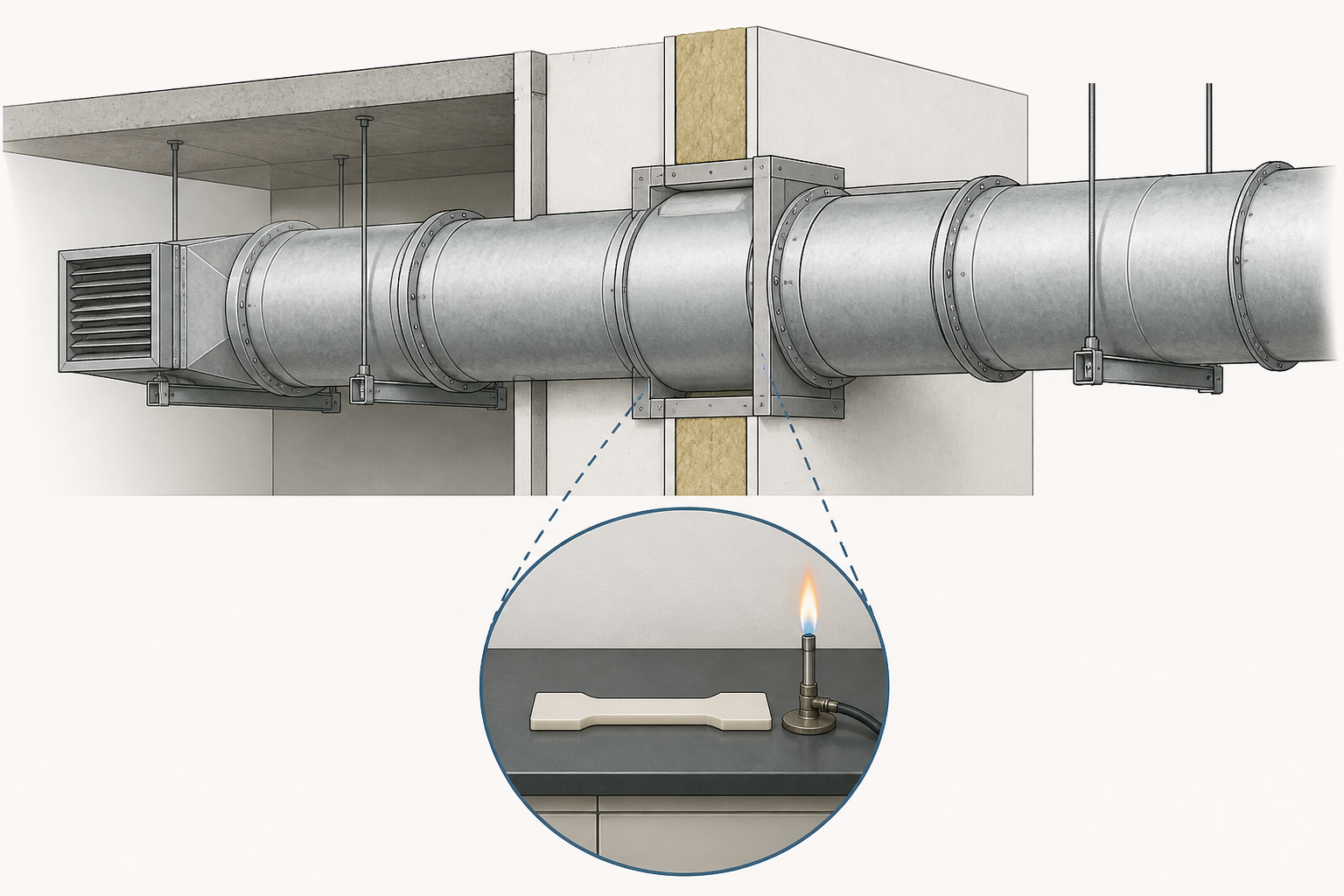
The illustration maps the three levels for a quick read; it is illustrative, not evidence. No image replaces the documents named in the ladder.
Decision point: If the project requires a fire-rated or smoke-control system, stop at the system-document gate because a material V-0 claim is not enough.
Engineering Inputs That Can Change the Material Choice
The material shortlist changes when the actual duty, geometry, construction and project evidence change. Every comparison above is conditional: a flame retardant duct candidate that passes the spelled-out service envelope survives, while the same resin name quoted for a different gas, temperature, diameter or support layout drops out. Treat the list as a live document: confirming the quoted geometry, joints and supports against the real run can promote or delete a material, and the buyer action is to turn every assumption into a confirmed field before ordering. The selection sequence is a working method, not a standard requirement; the applicable code and the responsible engineer still set the project’s fire and smoke gates.
Work the table as a check, and treat any field without a spec-grade document as Confirm for the specified grade/system rather than as a default property. A material label, compatibility chart or page value does not close a cell by itself.
| Input | Why it changes the choice | What to confirm |
|---|---|---|
| Gas and chemical list | Judged per stream; an unlisted gas invalidates an earlier vote | Full gas list vs the quoted grade’s compatibility statement |
| Concentration | Shifts corrosivity, dew point and the material class needed | Normal and peak concentration against the quoted grade’s test scope |
| Moisture and condensation | Condensation turns dry duty into wet chemistry the wall never faced | Dew point, wet/dry cycling and the drainage plan |
| Operating temperature | A usable range belongs to a grade, not a resin name | Documented operating range for the specified grade |
| Upset or peak temperature | A sustained peak can disqualify a material that passed normal duty | Credible upset duration and peak for the quoted grade |
| Ignition exposure | Raises the evidence level from material to system | Ignition sources and any fire-rated or smoke-control requirement |
| Diameter or airflow | Size sets velocity, pressure loss and section loads | Quoted diameter class and airflow against the duty |
| Wall thickness | A UL 94 claim belongs to a tested thickness; the wall must match it | Wall falls inside the tested thickness of the cited report |
| Operating pressure | Pressure changes section loads, seals and joint needs | Pressure class and leak test for the quoted system |
| Span, supports and impact | Support spacing and impact decide section suitability | Support spacing, unsupported span and impact exposure |
| Joint type and leak control | A run is only as sealed as its joints | Joint method, fit-up and leak test for the quoted system |
| Dampers | Add seals, moving parts and fire or smoke duty | Damper type, actuation, sealing and duty where fitted |
| Drainage | Pooling condensate changes the chemical duty inside the duct | Slope, low-point drains and drain materials |
| Inspection and cleaning access | Access decides whether the run can be maintained | Cleanout and access schedule matching the maintenance plan |
| Fire-rated or smoke-control requirement | Upgrades the evidence gate from material to assembly level | Assembly scope, documents and responsible authority |
Read the page values narrowly. The XICHENG flame-retardant PP ventilation pipe page lists a 500 mm class, pH 1–14 and a reference range from −15 °C to 80 °C that require project confirmation, not universal PP limits. The page does not establish a fixed wall thickness, pressure rating, service life or certification for this comparison; its socket and flange options are configuration fields, not tested joints. Use the three references as RFQ starting points — check the quoted 500 mm class against actual airflow, pH 1–14 against the real chemical list, and −15 °C to 80 °C against normal and peak temperatures — and let the specified grade and system documents close each cell. For a non-production worksheet, the later scenarios use 500 mm/10,000 m³/h/60 °C and 300 mm/4,000 m³/h/40 °C; they show the fields, not an operating recommendation.
Process Gas, Concentration, Moisture, and Temperature
Chemical exposure comes first because the gas list and its concentrations define what the duct wall must resist, and moisture compounds the question: condensation can turn a dry, compatible stream into a wet duty with new corrosivity. Labconco’s ductwork guidance applies this order in its laboratory context — chemical compatibility before comparing materials such as PVC, stainless and galvanized — and the same sequence keeps an industrial run honest. For a dedicated duct material for corrosive fumes review, keep the same condition-first order. Operating temperature sets the sustained range; upset and peak temperature is a separate, higher bound the grade must also cover. When any of these change, the same resin name can move from candidate to rejection.
Write the full gas list with normal and peak concentration, moisture behavior and both temperature bounds into the RFQ, and ask which document names the quoted grade against those conditions. If the reply names only a resin or a generic chart, leave the cell Confirm for the specified grade/system. Any PP duct advantages should be checked against those same inputs.
Diameter, Wall Thickness, Pressure, and Support
Geometry and mechanics sit outside the flame label. The quoted diameter and the airflow it carries set velocity, pressure loss and section loads, and wall thickness must match the cited material test scope because a UL 94 classification belongs to a specimen at a tested thickness, not to a wall size. For a non-round route, the plastic square tubing page is an inquiry path, while the duct schedule still controls the design. Operating pressure and support spacing are separate engineering inputs: a specimen flame result does not size a wall, a support spacing or an unsupported span, so those values come from the supplier’s duct schedule rather than from the material’s flame claim. The 0.7 mm, 1.5 mm and 3.0 mm values discussed in the UL 94 section are specimen-thickness references, not wall defaults. No pressure or spacing value is assumed; each is a confirmation field.
Confirm the quoted diameter class and airflow against the duty, then check that the wall falls inside the tested thickness of the cited report. Ask for the pressure class and leak test of the quoted system and the support spacing and span limits for the actual run, and treat any geometry cell without a document as Confirm for the specified grade/system.
Joints, Dampers, Drainage, and Inspection Access
A duct run is only as sealed as its joints, and dampers, drains and access points add their own requirements. On the XICHENG flame-retardant PP ventilation pipe page, socket and flange are configuration options that define how sections connect — configuration fields only, not evidence of a tested joint. Dampers add seals, moving parts and fire or smoke duty where fitted; pooled condensate changes the chemical duty inside the duct; and inspection access decides whether the run can be cleaned and checked in service. None of these details is covered by a V-0 specimen label.
Confirm the joint type, fit-up and leak test, the damper types and sealing, the slope and low-point drains, and the cleanout and access schedule for the quoted system. Carry each confirmed detail into the supplier RFQ, and where a joint, damper or drainage document is missing, write Confirm for the specified grade/system instead of assuming the need is covered.
When the project requires a fire-rated or smoke-control system, the material check stops at the system-document gate: UL 94 remains material-specimen evidence, while fire-rated or smoke-control ductwork is judged at assembly level. Confirm the specified assembly scope and the responsible authority, and let the project documents settle the question rather than the material shortlist.
Decision point: Do not approve the material until the quoted duct geometry, joints and supports have been checked against the actual duty.
Two Selection Scenarios: Corrosive Exhaust and Ignition Exposure
ILLUSTRATIVE ONLY — not a project specification
Two worked scenarios do not produce a universal material answer; they produce a reusable verification sequence. Scenario A and Scenario B show which question decides first, which document closes it, and where the material comparison must stop — not which family wins between PP, PVC and metal. The two duties probe different axes: Scenario A stresses chemistry and construction, Scenario B stresses the evidence level once an ignition question appears. Every scenario conclusion below is engineering inference, not a test result, and none of the numbers is a design value, product limit or passing outcome. Read the two sequences as question generators, then carry the generated questions into the RFQ for the real project.
The demonstration inputs exist only to give each sequence a concrete shape. They are illustrative inputs only, not design values: Scenario A uses 500 mm, 10,000 m³/h and 60 °C; Scenario B uses 300 mm, 4,000 m³/h and 40 °C. Do not turn them into product limits, XICHENG parameters or test results.
| Demonstration input | Scenario A — wet, acidic process exhaust | Scenario B — dry process exhaust with an ignition concern |
|---|---|---|
| Diameter | 500 mm |
300 mm |
| Airflow | 10,000 m³/h |
4,000 m³/h |
| Operating temperature | 60 °C |
40 °C |
The three rows are placeholders that mean nothing until the gas list, concentration range, moisture behavior and ignition exposure sit next to them. What follows is the verification order each duty forces — first a wet acidic stream, then a dry stream with an ignition concern — and both orders end at the same rule: no family passes without documents.
Scenario A — Wet, Acidic Process Exhaust
Scenario A is a chemistry problem before it is a material problem, so the decision sequence starts with the gas list and its concentration range, then moves to moisture and condensation behavior, then to normal and upset temperatures. The order matters because condensation routinely turns a nominally compatible stream into a wet duty the chart never covered; Labconco’s ductwork guidance applies chemical compatibility first in its laboratory context, and this scenario borrows that sequence as a check order rather than a laboratory verdict. Only after chemistry is fixed can a candidate raise a compatibility document naming the quoted grade, and only then do drainage slope, low-point drains, joints and supports enter the ranking; a flame-retardant PP option can join the conversation — the XICHENG flame-retardant PP ventilation pipe page cites pH 1–14 as a product-page reference — but no family passes on page references alone.
The failure limits in Scenario A are documents, not materials: an unlisted gas, a concentration above the chart, pooled condensate at a low point, a sustained upset temperature, or a joint and support layout nobody checked. Each limit converts to an RFQ line — the full gas list with concentrations, moisture and condensation behavior, normal and upset temperatures, the compatibility document for the quoted grade, the drainage and joint plan, the support schedule, and the written system requirement (fire-rated, smoke-control, or explicitly none). The XICHENG page’s 500 mm class, pH 1–14 and −15 to 80 °C are product-page references needing project confirmation, not universal PP limits, so they answer none of those lines by themselves. Leave any candidate without its documents as Confirm for the specified grade/system; no “which family wins” answer is valid until those documents exist.
Scenario B — Dry Process Exhaust With an Ignition Concern
Scenario B separates the dry duty from the ignition exposure, because the two questions are not the same risk. The dry label describes normal operation, not the event: the duty at 300 mm, 4,000 m³/h and 40 °C is checked first as chemistry and moisture — gas list, concentration range, and whether the stream runs dry full-time or cycles through condensation — and only then does the ignition exposure raise the evidence level, covering the ignition sources present, the upset conditions that could create one, and what the specification demands if a fire or smoke event hits the run. Merging the two questions is the scenario’s main trap, because a chemically easy dry stream can still carry sparks or a hot surface that a material label never addressed.
For the ignition exposure the buyer asks for the ignition sources in the process, the material grade for the quoted formulation with its tested thickness and the report behind it, plus the construction data for joints and supports. V-0 remains specimen evidence: UL Solutions describes UL 94 as a classification of plastic specimens under controlled laboratory conditions, so the label answers how the tested specimen behaves and nothing about the installed run, its joints or a fire rating. The RFQ therefore asks for the fire and smoke requirement in writing instead of accepting a V-0 label as the answer, and any reply that offers only the label without grade, thickness and report is incomplete.
What Changes When a Fire-Rated System Is Mandated
A mandated fire-rated or smoke-control system moves the gate from the material to the assembly, and both scenarios stop being material comparisons at that point. The material-specimen evidence established earlier — through UL Solutions — cannot bear an assembly requirement; UL Code Authority distinguishes fire-resistive and fire-protective ventilation duct assemblies as system-level designations judged through system documents rather than single-grade labels. Scenario A and Scenario B continue only as long as no fire-rated or smoke-control requirement is stated; the moment the mandate appears, the question moves from which grade to which assembly documents and which responsible authority approves them.
The buyer action changes with the gate: request the specified assembly scope, the documents covering the installed run — sections, joints, supports and penetrations — and confirmation from the responsible engineer, EHS or facility authority. No scenario answer converts a material classification into a fire rating, and no demonstration value from either scenario becomes a system requirement. Treat the mandate as the end of the material shortlist and the start of a system-document review.
Decision point: Use the scenarios to generate verification questions, not to copy a material answer into another project.
What to Request Before Ordering Flame Retardant Duct
A supplier reply that says only “V-0” is incomplete for a flame retardant duct order. A UL 94 classification belongs to one formulation at one tested thickness, and it says nothing about the installed run, its joints or the project’s fire or smoke requirement. Ordering is the second verification pass: the earlier shortlist decides which materials survive, and this RFQ closes every open cell with documents.
Split the request into two packages: material-level evidence and system-level scope. Material evidence proves what the flame claim actually tested; system scope defines what the installed run, its accessories and the project requirement demand. A reply that blurs the two — a V-0 label offered as proof of a fire-rated system — is the exact failure this module exists to block. The checklists below and the copy-and-send RFQ keep the gap visible.
Material and Test Evidence
Start with the specimen, because UL 94 is material evidence. UL Solutions describes UL 94 as a classification of plastic specimens under controlled laboratory conditions, so the report must prove the tested material is the quoted material: same grade, same tested thickness, same standard edition. The checklist has five lines — the exact formulation or grade; the tested thickness in the report, not a wall promise; the standard edition the classification cites; the test report, or the Yellow Card where applicable; and confirmation that the quoted duct wall falls inside the tested thickness. Ratings move with formulation and thickness, which is why Protolabs reminds buyers that the Yellow Card, where one exists, covers the specific formulation and thickness — a bare label without those bindings proves nothing about your wall.
Read the supply statement and the evidence separately. The XICHENG flame-retardant PP ventilation pipe page says a V-0 flame retardant grade is available and is confirmed per project; that is a supply statement, not a certification, not a UL listing and not a Yellow Card approval. For the material-test request, identify the specimen context too: the S1 vertical setup uses a 125 mm × 13 mm specimen, a 20 mm flame and cotton 300 mm below; those are test references, not duct dimensions. The page also states the product is not a substitute for certified fire-rated or smoke-control ductwork, which is the boundary the evidence package must respect. Any material cell without its document stays Confirm for the specified grade/system instead of becoming an order.
Duct Schedule and System Requirements
The second package covers the installed run. Ask for the duct schedule: diameter and airflow, wall thickness, operating pressure, support spacing and span, and impact exposure — and treat geometry as confirmation fields, not defaults, because no flame label sizes a wall or a support. Two connection fields must stay separate in your file and in the supplier’s reply: (1) joint type and assembly method — socket, flange, welded or specified, with fit-up and seal details — and (2) leak-control and test requirement — the leak test method and acceptance at the quoted pressure. A duct run is only as sealed as its joints, so a reply that names the joint but no test is half an answer.
Then add the accessories and the system gate. Dampers need type, actuation, sealing and any fire or smoke duty where fitted; drainage and inspection need slope, low-point drains, cleanouts and an access schedule. If the project carries a fire-rated or smoke-control requirement, UL Code Authority distinguishes fire-resistive and fire-protective ventilation duct assemblies and describes ISO 6944’s basis in stability, integrity and insulation; assembly-level claims can cite scope labels such as ISO 6944 or ASTM E2816, and none of those identifiers converts into a UL 94 material grade. Ask who approves the assembly — the authority having jurisdiction, the responsible engineer or EHS — and put that name on the RFQ.
Keep the page references bounded. The XICHENG flame-retardant PP ventilation pipe page lists a 500 mm class, pH 1–14 and a reference range from −15 °C to 80 °C as product-page references that need project confirmation against the duty — not universal PP duct limits. Treat them as RFQ starting points: check the 500 mm class against actual airflow, pH 1–14 against the real chemical list, and −15 °C to 80 °C against normal and peak temperatures, and let the quoted grade and system documents close the cells.
Unconfirmed values are blockers. Where no document exists, write Confirm for the specified grade/system rather than assuming a pressure, a support spacing, a service life, a price, a smoke or toxicity figure, an oxygen index or a fire hour.
A Copy-and-Send RFQ Template
The template below is written to be copied verbatim into your inquiry. It carries more than the eight required request fields, and the two connection fields — joint type and assembly method versus leak-control and test requirement — sit on separate lines so the supplier cannot merge them. For orientation only, an illustrative form can carry 500 mm at 10,000 m³/h and 60 °C, or 300 mm at 4,000 m³/h and 40 °C; label these as placeholders and replace them with the project duty. Replace every bracketed placeholder, then send the RFQ.
RFQ — Flame Retardant Duct  |  Project: [project name]  |  Date: [date]  |  Quote reference: [supplier quote no.]

1. SERVICE DUTY
- Process gas / chemical list and concentration: [list each gas or vapor; normal and peak concentration]
- Moisture / condensation: [wet, dry, or cycling; dew point where known]
- Normal operating temperature: [value and unit]
- Upset / peak temperature: [value and unit; credible duration of the upset]

2. GEOMETRY AND MECHANICAL
- Diameter / airflow: [nominal diameter class and design airflow]
- Wall thickness: [quoted wall thickness — must sit inside the tested thickness of the cited report]
- Operating pressure: [pressure class]
- Supports / span / impact: [support spacing, unsupported span, impact exposure]

3. CONNECTION — TWO SEPARATE FIELDS
- (1) Joint type / assembly method: [socket, flange, welded, or specified method; fit-up and seal details]
- (2) Leak-control / test requirement: [leak test method and acceptance at the quoted pressure]

4. ACCESSORIES
- Dampers: [type, actuation, sealing, and fire or smoke duty where fitted]
- Drainage / inspection: [slope, low-point drains, cleanouts and access schedule]

5. MATERIAL EVIDENCE
- Formulation / grade: [exact grade quoted]
- Tested thickness: [thickness in the test report — not a wall promise]
- Standard edition: [edition the classification cites, e.g. a UL 94 edition]
- Test report / Yellow Card: [report or Yellow Card number and issuing body, where applicable; must name the exact grade and tested thickness]

6. SYSTEM REQUIREMENT
- Fire-rated / smoke-control requirement: [specified assembly scope — fire-resistive or fire-protective — and stability, integrity, insulation where specified]
- Responsible authority: [authority having jurisdiction, responsible engineer, or EHS contact for approval]

7. DELIVERY AND INSPECTION (optional)
- [Inspection and test documents that must accompany delivery]

Supplier reply requirements:
- Name the exact grade, tested thickness and standard edition.
- Attach the test report or Yellow Card, where applicable, for the quoted formulation and thickness.
- Confirm each cell against the duty; write "Confirm for the specified grade/system" where a document is still pending.
- State the fire-rated / smoke-control requirement for the quoted system in writing, with the responsible authority.
Read the reply against that standard: it must name the exact grade, the tested thickness and the standard edition, attach the test report or Yellow Card where applicable, confirm each duty cell against the quoted system, and state the fire-rated or smoke-control requirement with the responsible authority. Anything less leaves a field open. Where the supplier returns only a V-0 label, the correct next step is not a price decision but a request to complete the evidence.
Use the XICHENG flame-retardant PP ventilation pipe page as the inquiry path to send this RFQ. The XICHENG flame-retardant PP page states a V-0 flame retardant grade is available and confirmed per project — an invitation to request the evidence above, not an acceptance of certification.
For a general PP configuration route, review the polypropylene PP air duct supporting product page and send the completed fields through the contact page.
Decision point: Place the order only when the returned material evidence and system scope match the RFQ, not a generic “flame-retardant” label.
Frequently Asked Questions
Is Flame-Retardant PP Duct Fire Rated?
No — flame-retardant PP can be a material candidate, but the flame claim does not make the installed duct fire rated. A V-0 grade describes a plastic specimen under controlled laboratory conditions, per UL Solutions, while fire-rated and smoke-control ductwork are system-level designations judged at assembly scope, per UL Code Authority. The XICHENG flame-retardant PP ventilation pipe page likewise states it is not a substitute for certified fire-rated or smoke-control ductwork.
Whether the project needs a fire-rated or smoke-control system is answered by the code, the specification and the responsible engineer, EHS or AHJ — check that document before treating any material label as the answer.
Does UL 94 V-0 Prove Low Smoke or Low Toxicity?
No. UL 94 V-0 is a specimen flame classification: UL Solutions describes it as a classification of plastic specimens under controlled laboratory conditions, and the result records flame behavior — after-flame, afterglow and burning drips — not smoke generation or combustion toxicity. Smoke and low toxicity are separate questions that require separate evidence, so a V-0 label cannot be read as proof of either.
Ask which test report covers smoke and products of combustion for the quoted grade; if the supplier returns only V-0, keep the smoke and toxicity cells pending rather than proven.
Is Metal Ductwork Automatically Fire Rated?
No. Metal ductwork is not fire-rated simply because it is metal; the fire or smoke designation belongs to the installed assembly, judged through assembly-level and project documents, per UL Code Authority. Sections, joints, supports, penetrations and the specified assembly scope all have to be checked against the project’s fire or smoke requirement, and material identity alone does not close that gate.
If the specification names a fire-rated or smoke-control system, request the assembly documents and confirm the responsible authority — the AHJ, the responsible engineer or EHS — before continuing the material comparison.
What Information Is Needed for a PP Duct Quotation?
A usable PP duct quotation covers the same fields as the RFQ in the previous section: process gas and chemical list with concentrations, moisture, operating and peak temperature; diameter and airflow; wall thickness; pressure, supports and spans; joints and leak control; dampers, drainage and inspection access; the material test evidence — grade, tested thickness, standard edition and report; and the system requirement with the responsible authority. A reply that offers only a “flame-retardant PP” label or a V-0 grade without those fields is incomplete, and a V-0 supply statement such as the one on the XICHENG flame-retardant PP ventilation pipe page is confirmed per project, not an automatic answer to any of the fields.
Send the RFQ with every field filled, and ask the supplier to return a document for each line; any field without a document stays Confirm for the specified grade/system.
Decision point: When an answer depends on a project document, treat it as a verification task rather than an assumed material property.