
Key Takeaways
- PP duct vs galvanized duct is a screening decision, not a material-label contest. Start with the actual effluent, concentration, operating temperature, and condensation risk before comparing price or weight.
- A PP duct is a polypropylene exhaust-duct candidate for corrosive-duty projects, while a galvanized duct is a zinc-coated steel candidate whose coating designation and construction details still need specification. Neither phrase is a chemical-compatibility approval.
- Salt spray is not service life. ASTM B117 describes a test environment; it does not prescribe exposure time or interpret a result as field life.
- Comparable quotes need the same scope. Send duct section, length, wall thickness, PP grade, GI coating designation, joints, supports, installation, and maintenance access in both RFQs.
Choosing between PP duct and galvanized duct starts with the exhaust stream, not with a generic “plastic versus metal” preference. A wet or corrosive stream that can condense needs a documented chemical-compatibility review and joint/drainage details before material selection. A dry particulate run with higher mechanical-duty or temperature requirements may keep galvanized steel in the candidate set, but “galvanized” still does not state the coating designation, sheet thickness, reinforcement, or connection method.
The useful question is therefore not which material lasts longer in every plant. It is which material system can be specified for the actual effluent, temperature, moisture exposure, fire requirement, duct geometry, and installation scope. This guide uses that order so an engineering or procurement team can turn a first comparison into a reviewable specification instead of a price-only choice.
PP duct vs galvanized duct: the direct answer
PP duct is often a candidate where corrosive exhaust or recurring moisture makes chemical compatibility the first decision. Galvanized steel duct is often a candidate where dry particulate service, mechanical construction, or higher-temperature system requirements lead the review. Those are screening paths, not final approvals: confirm the gas list, concentration, operating and peak temperature, condensation exposure, governing code, duct geometry, supports, and joints before selecting either material.
For a broader material map beyond this two-material screen, use the ventilation duct materials comparison before narrowing the project-specific shortlist.
| Decision input | PP duct path | Galvanized duct path | What to confirm before selection |
|---|---|---|---|
| Effluent and moisture | Consider for corrosive-duty exhaust after checking the actual chemical, concentration, temperature, and condensate exposure. | Do not assume a zinc coating resolves wet or chemically active exposure. | Gas/vapor list, concentration, water source, low points, and condensate path. |
| Coating or material specification | Confirm PP grade and permitted operating range in the supplier’s written system data. | State the steel grade and coating designation; G90/Z275 identify coating mass, not a life guarantee. | Datasheet, coating designation, cut-edge treatment, and applicable standard edition. |
| Temperature and fire | Confirm the complete duct system’s written rating and the project fire requirement. | Confirm the complete duct system, seals, joints, and supports—not only the zinc coating. | Continuous and peak temperature, code, tested configuration, and authority requirements. |
| Reference values, not ratings | GF 0–80 °C is an industrial piping reference only. | GAA 200 °C continuous / 275 °C occasional is hot-dip coating guidance only. | ASTM A653/A653M G90 0.90 oz/ft² / Z275 275 g/m²; XICHENG public configuration 500 mm / 600 mm. |
| Geometry and support | Confirm section shape, wall thickness, flange reinforcement, spans, hangers, and service access. | Confirm sheet thickness, reinforcement, joints, spans, hangers, and service access. | Drawings, supports, access points, and drainage slope. |
| Quote comparison | Request PP grade, wall thickness, joints, supports, transport, installation, and maintenance scope. | Request GI designation, sheet thickness, joints, supports, transport, installation, and maintenance scope. | Like-for-like RFQ line items, not a material-only unit price. |
Decision point: classify the exhaust stream and condensation risk first; if those inputs are missing, do not choose PP or galvanized duct yet—request them before asking for a final material recommendation.
Start with the effluent and condensation risk
Effluent is more than a chemical name
Treat the stream description as the first material-selection input, not as a label such as “acid exhaust.” The assessment should identify whether the effluent is a vapor, fume, chemical gas, or particulate, then record its acidity or causticity, average temperature, concentration, and quantity. The BHDP selection framework also identifies run configuration, shared-stream interaction, ambient humidity, condensation behavior, and construction quality as decision inputs.
Collect normal and credible operating conditions before comparing PP duct with galvanized duct. A stream that sounds simple at one pickup point may change when it joins another branch, travels through a long run, or enters a section where moisture can form. The comparison therefore needs a project data sheet that preserves both the process inputs and the physical duct arrangement.
| Input category | Fields to collect |
|---|---|
| Effluent | Stream type; chemical constituents; acidity or causticity; particulate presence |
| Operating condition | Average temperature; concentration; quantity; normal and changing conditions |
| Moisture | Ambient humidity; moisture in stream; known or expected condensation locations |
| Duct layout | Run length; branch arrangement; fittings; vertical and horizontal sections |
| Stream interaction | Shared branches; mixing points; other connected exhaust sources |
| Construction | Proposed connection method; installation constraints; quality-control responsibility |
Condensation turns a duct detail into a material input
Treat condensation as a design condition because it changes what contacts the internal duct surface. UK Defra guidance warns that liquid condensation on internal flue or exhaust-duct surfaces can lead to corrosion and ductwork failure. A gas-phase description alone is therefore incomplete when operating or ambient conditions can produce liquid inside the system.
Map where condensation is observed or expected, including branches, transitions, low points, and sections exposed to changing ambient humidity. Then identify which constituents may be present in the liquid and which shared streams could meet before or after condensation occurs. This step establishes the real exposure case before the article moves into galvanized coating considerations or temperature screening.
When PP is a candidate, not an automatic answer
Put PP on the candidate list when the project involves corrosive gas exhaust, a use case identified by the XICHENG PP exhaust duct page. That listing is not a blanket compatibility statement for every chemical or operating condition. The actual gas composition, concentration, operating temperature, moisture, and proposed connection method still need project-specific confirmation.
For a rectangular route, the PP rectangular duct range is the relevant product-side follow-up; it does not replace the compatibility review.
Keep galvanized duct in the same screening process until the collected inputs allow a defensible comparison. Do not select PP from the chemical name alone, and do not reject galvanized duct before examining the complete stream and condensation case. Construction quality must remain part of the review because material choice cannot compensate for an unsuitable or poorly controlled installation approach.
The GF 0–80 °C figure and the XICHENG 500 mm / 600 mm configuration boundaries are reference points, not substitutes for the project’s actual temperature and section-size inputs.
Decision point: State and list the effluent, moisture, layout, stream-interaction, and construction fields before comparing galvanized coating suitability or temperature limits; do not use the 0–80 °C piping value or 500 mm / 600 mm configuration boundaries as substitutes for actual service data.
Specify the galvanizing, then reject salt-spray shortcuts
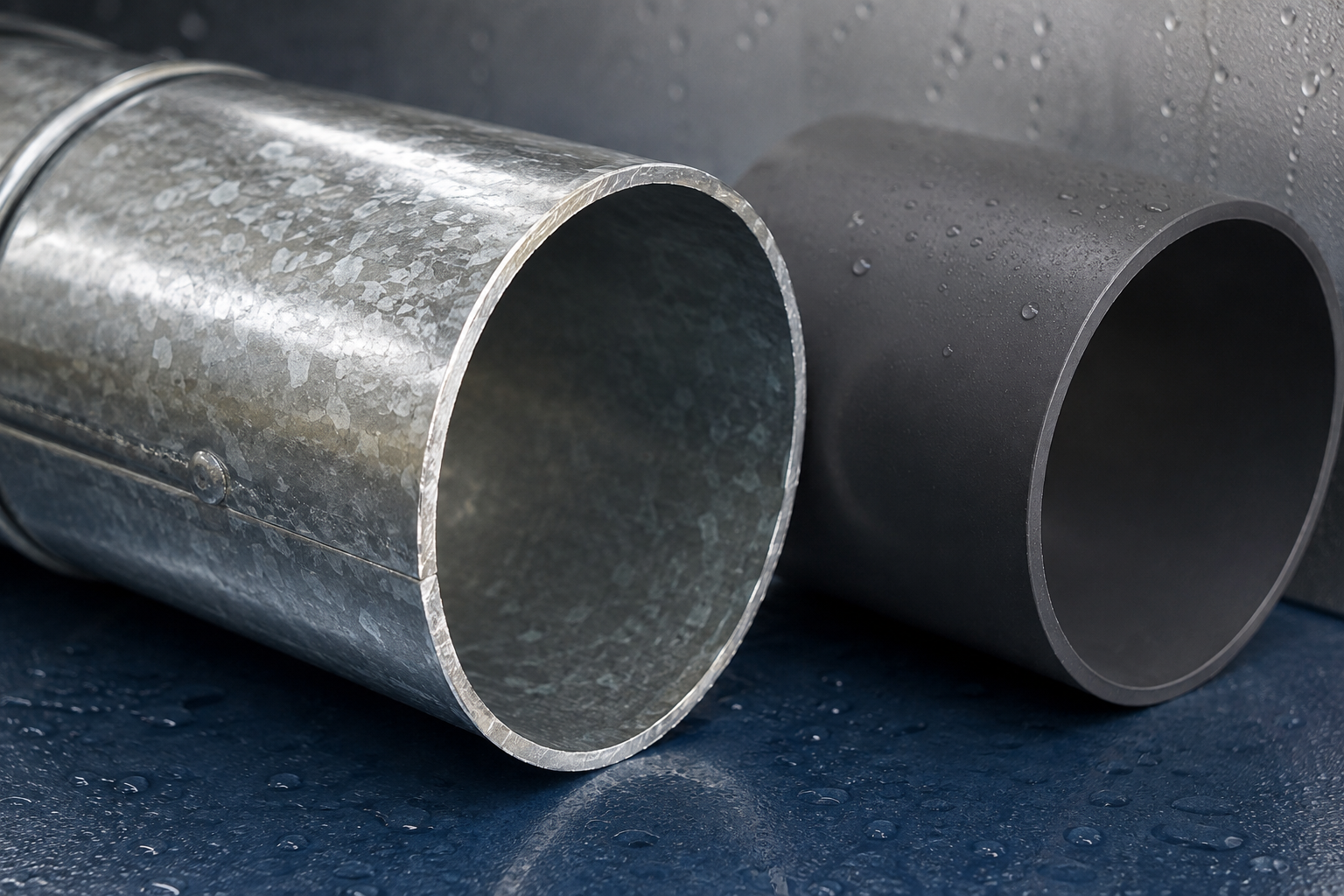
Galvanized steel is a coated system, not a single corrosion rating
“Galvanized duct” is not a complete material specification. ASTM A653/A653M covers zinc-coated and zinc-iron alloy-coated steel sheet, identifying coating-weight or coating-mass designations alongside mechanical grades. The word galvanized alone does not establish the grade, coating designation, strength, duct construction, or expected service life.
Treat galvanized steel as a specified coated system rather than a universal corrosion category. Procurement documents should identify the applicable sheet standard, coating designation, mechanical requirements, and fabrication details, then describe the exhaust environment separately. This distinction matters because atmospheric corrosion resistance generally trends with zinc coating thickness or mass, but that trend does not provide a fixed corrosion rate or guaranteed lifetime.
What G90 and Z275 actually state
G90 and Z275 are coating-mass designations, not chemical-resistance classes. Under the public tables associated with ASTM A653/A653M, G90 requires a minimum triple-spot coating weight of 0.90 oz/ft² total across both sheet surfaces. Z275 is the corresponding SI designation, requiring 275 g/m² total across both surfaces.
| Designation | Measurement system | Minimum triple-spot coating mass, total both sides |
|---|---|---|
| G90 | Inch-pound | 0.90 oz/ft² |
| Z275 | SI | 275 g/m² |
State the designation and expected wet or chemical exposure in the RFQ; G90 (0.90 oz/ft²) and Z275 (275 g/m²) identify coating mass, not service life or a chemical-resistance class. Service suitability still depends on wetting, contaminants, condensation, maintenance, and construction details.
Why ASTM B117 cannot select duct service life
ASTM B117 defines apparatus and operating conditions for a controlled salt-spray environment. It does not prescribe the product specimen, exposure duration, or interpretation needed to convert a test result into field performance. Stand-alone salt-spray results therefore rarely correlate predictably with natural exposure and should not be translated from test hours into service years.
Salt spray is not service life. The American Galvanizers Association explains that continuous 5% sodium-chloride fog can prevent formation of zinc’s protective carbonate film, producing a corrosion mechanism unlike typical field exposure. A supplier’s salt-spray result may support a defined comparative test program, but it cannot by itself establish duct lifetime or suitability for a wet or chemically contaminated exhaust stream.
Decision point: State the galvanized coating designation and the expected wet or chemical exposure, and reject any supplier claim that converts unsupported salt-spray duration into duct service life.
Compare temperature and fire requirements as system limits
Do not turn a PP piping value into a PP duct rating
Temperature data for one PP product cannot define the allowable conditions for another. For example, GF Piping Systems states a 0–80 °C range for its PROGEF beta-PP-H industrial piping system, but that range does not rate XICHENG PP exhaust duct, fabricated joints, dampers, supports, or field connections.
An isolated material datum should not be used as a PP duct rating. Designers comparing PP duct vs galvanized duct should request a written limit for the complete proposed PP system under the actual airflow, pressure, chemical exposure, installation, and upset conditions.
| Reference boundary | Published value | What it does not rate |
|---|---|---|
| GF PROGEF beta-PP-H industrial piping system | 0–80 °C | XICHENG PP exhaust duct or its complete installed system |
| XICHENG PP exhaust duct public product page | No universal temperature value used here | A complete PP duct system under the project’s airflow, pressure, chemicals, joints, and installation conditions |
| GAA hot-dip galvanized zinc-coating guidance | Approx. 200 °C continuous; 275 °C occasional | Pre-galvanized duct or a complete galvanized duct system |
Do not turn a galvanized-coating limit into a duct-system rating
The GAA temperature guidance gives approximate boundaries of 200 °C for continuous exposure and 275 °C for occasional exposure of hot-dip galvanized coatings. These figures describe the behavior of a zinc coating in that context; they are not universal temperature ratings for galvanized exhaust ductwork.
They do not establish limits for pre-galvanized sheet, seams, gaskets, sealants, connectors, fasteners, supports, or other assembled components. Compare supplier documentation at the complete-system level; the table values are screening boundaries, not a XICHENG PP duct or galvanized duct system rating.
Fire performance belongs to the governing code and tested configuration
Temperature capability and fire performance answer different questions. A material designation, zinc-coating guideline, or reference to plastic flame-retardant grades does not by itself establish flame-spread behavior, smoke performance, fire resistance, or acceptance by the authority having jurisdiction.
Review must address the governing building, mechanical, fire, and process-safety requirements for the project location and occupancy. The engineer of record (EOR) and environmental, health, and safety (EHS) team should check the specified duct construction, joints, penetrations, dampers, supports, clearances, detection or suppression measures, and any required tested configuration rather than infer compliance from a base material.
Decision point: State the supplier’s complete-system limit and select the EOR/EHS review path when conditions exceed it; do not substitute the 0–80 °C piping, 200 °C coating, or 275 °C coating references for a project rating.
Check rigidity, support, shape, and service access
After temperature and fire screens, review geometry and construction before advancing either candidate.
A material label does not specify wall thickness or reinforcement
“PP” and “galvanized” identify material families, but they do not define the wall thickness, reinforcement, support arrangement, or fabrication details needed for an industrial exhaust run. The public ASHRAE duct construction chapter directs industrial duct material, thickness, and reinforcement choices to SMACNA industrial duct construction guidance, confirming that these features must be selected as part of the design.
Ask each supplier to show how the proposed construction corresponds to the duct size, shape, routing, and expected service conditions. A useful comparison should identify what is included in the quoted configuration and what still requires project-specific engineering, rather than treating one material name as a complete structural specification.
PP duct needs its own stiffness and reinforcement review
PP construction can change with section size and fabrication method. The XICHENG PP exhaust duct page describes injection-molded sections to 600 mm and larger sheet-welded work above 500 mm with flange reinforcement; this is a product-page configuration boundary, not proof of pressure capacity, support spacing, deflection performance, or a universal industry rule.
Review the offered PP configuration on its own terms, including seams, flanges, reinforcement locations, supports, and access openings. Apply the same discipline to galvanized duct: confirm the specified construction rather than assuming the substrate or coating answers structural questions automatically.
| Structural review item | What to request from the supplier or designer | Why it matters |
|---|---|---|
| Section size and shape | Fabrication method and section details | Construction may change across the run |
| Wall and reinforcement | Project-specific thickness and reinforcement schedule | The material label does not define stiffness |
| Supports | Designed support layout and attachment details | Routing and equipment interfaces affect loading |
| Access openings | Locations, framing, and removable-clearance needs | Openings can affect construction and maintenance |
| Public configuration boundary | XICHENG describes injection-molded sections to 600 mm and larger sheet-welded work above 500 mm | These values do not rate stiffness, pressure, deflection, or support spacing |
Round runs, low points, and maintenance access change the risk
According to BHDP, round ducts offer more uniform velocity, reduce settling risk, withstand higher static pressure, and can be sealed more readily. These are design considerations rather than guaranteed project outcomes; fittings, transitions, fabrication, and the complete system layout still need review.
Map low points, horizontal runs, cleanout locations, inspection access, and the space required to remove components without disturbing adjacent equipment. For fume-hood service, BHDP advises sloping runs back toward the hood so condensate can drain; record that slope and any drain path on the route drawing before the joint detail is chosen. This makes the next review of joints and drainage inseparable from the geometry decision.
Decision point: Advance a PP or galvanized option only when its proposed shape, construction, reinforcement, supports, access, and low-point strategy have been documented for the actual route.
Choose joints and drainage details before comparing installation
PP joints: socket, flange, or hot-air welding
After identifying geometry and low points in the previous section, define how each section will connect. The XICHENG PP exhaust duct page lists socket, flange, and hot-air-weld connections, but that list does not make the options interchangeable. The design team should specify the joint type by location so fabricators and bidders interpret the layout consistently.
For hot-air-welded joints, the specification should identify an applicable procedure and workmanship requirements. ASTM D2657 covers heat fusion of polyolefin pipe and tubing; check its scope against the specified duct joint before citing it. The reference does not establish universal weld strength, installation speed, or project outcomes. For the broader fabrication sequence, see how PP plastic duct is made, while keeping this joint decision project-specific.
Neither the public 500 mm nor 600 mm configuration boundary determines the joint, and the 0–80 °C piping figure cannot select a connection method. Assign the joint by location and confirm the route-specific procedure.
| Review item | PP duct | Galvanized duct |
|---|---|---|
| Connection options | Socket, flange, or hot-air weld | Seams, flanges, clamps, or welded configurations |
| Drawing requirement | Mark joint type by location | Identify the system-specific connection |
| Workmanship check | State the applicable joining procedure | Check construction and joint details |
| Drainage check | Coordinate joints with slope and low points | Coordinate joints with slope and low points |
Galvanized joints: connection method depends on the system
Galvanized duct should not be described as requiring one universal connection method. Depending on the duct system and its construction, connections can include seams, flanges, clamps, or welded configurations. Use the connection arrangement shown in the project documents rather than treating “galvanized” as a complete joint specification.
Ask each bidder to identify the proposed connection at straight sections, fittings, branches, equipment interfaces, and access points so the method is traceable on drawings. Coordinate joint construction with the selected duct system and the conditions at each location.
Drainage and workmanship can override a material preference
Material preference alone cannot correct a joint or layout that traps liquid. BHDP notes that joint and construction defects can collect effluent and become future failure points; it also advises considering slope in round ducts and hood runs so condensate can return or drain. Defra guidance likewise warns that condensation can contribute to corrosion and failure.
Record the slope direction, low points, drainage path, and joint placement on the route drawing before selecting the installation concept. A preferred material remains provisional if the layout leaves condensate at a connection or the workmanship requirements are unclear.
Decision point: Approve the material comparison only after every joint type, slope direction, low point, and drainage route is defined.
Compare quotes on the same scope—not on a price claim
Turn the joint and drainage review into matching RFQ fields before comparing totals.
The fields that make PP and GI quotes comparable
Issue both suppliers the same operating conditions, dimensions, quantities, site constraints, and scope boundaries. Require itemized responses so each included component and service can be compared line by line.
| RFQ field | PP duct quote | Galvanized steel (GI) duct quote |
|---|---|---|
| Service conditions | Exhaust composition, concentration, temperature, pressure, humidity, and operating schedule | Same service conditions |
| Duct geometry | Section, shape, dimensions, total length, fittings, branches, and quantities | Same geometry and quantities |
| Base material | PP grade and applicable material specification | Steel grade and applicable sheet specification |
| Wall or sheet | Wall thickness by component | Sheet thickness or gauge by component |
| Surface protection | State any specified surface treatment | GI coating designation and coating standard |
| Joint system | Hot-air-welded, flanged, socket, or other joint details | Flanged, seam, clamp, welded, or other connection details |
| Reinforcement | Flanges and other reinforcement, including spacing | Stiffeners, flanges, and other reinforcement, including spacing |
| Cut edges | Not applicable or supplier clarification | Cut-edge treatment and repair method |
| Supports | Support type, material, spacing, anchors, and interface limits | Same support details |
| Transport | Packaging, section lengths, delivery, unloading, and site storage | Same transport scope |
| Installation | Assembly, lifting, field joints, sealing, testing, and commissioning | Same installation scope |
| Access and maintenance | Access doors, cleaning provisions, inspection needs, and maintenance responsibilities | Same access and maintenance scope |
| Commercial boundaries | Included quantities, written exclusions, assumptions, options, and validity | Same commercial boundaries |
For GI, ask for the coating designation rather than accepting “galvanized” alone. Under ASTM A653/A653M, G90 means 0.90 oz/ft² and Z275 means 275 g/m²; these are coating-mass designations, not service-life or price specifications.
If a quote cites a 5% sodium-chloride salt-spray setup, record it as a test condition rather than a field-life promise. When both designation forms are offered, preserve 0.90 oz/ft² and 275 g/m² in the comparison so the units are not silently dropped.
What not to accept as a comparison
Do not compare a PP material-only supply against a GI installed system, or one complete quote against another that omits supports, fittings, transport, access provisions, or field work. A lower total without matched line items, written exclusions, and explicit assumptions does not establish equivalent scope or correct material selection.
Send this copyable request: “Please use our contact channel to quote PP and galvanized steel duct on matching dimensions, quantities, service conditions, joints, reinforcement, supports, transport, installation, access, and maintenance requirements, while itemizing material specifications and listing every exclusion and assumption in writing.” The next module’s worked examples show how these fields expose scope differences between apparently similar offers.
Decision point: Compare only like-for-like line items, state the applicable 0.90 oz/ft² or 275 g/m² coating designation, and resolve every written exclusion and assumption before advancing either quote.
PP duct vs galvanized duct: a wet acid-fume branch versus a dry dust run

Scenario A: wet acid-fume branch
All numerical inputs are ILLUSTRATIVE ONLY and form a planning example, not duct sizing or system design. Scenario A is a 300 mm round branch with a 12 m route and 6 m vertical rise, carrying an acid fume whose exact composition and concentration are not yet confirmed, with condensate observed at one low point.
The wet, chemically uncertain service makes PP a candidate, not an automatic selection. The XICHENG PP exhaust duct page identifies PP duct for corrosive exhaust applications, while BHDP emphasizes matching hazardous-exhaust duct construction to the actual contaminants and operating conditions; therefore, the chemical-compatibility basis, PP grade, actual temperature, joint method, drainage arrangement, reinforcement, and support design must be documented before PP remains in consideration.
Scenario B: dry particulate collection run
Scenario B uses the same ILLUSTRATIVE ONLY planning dimensions: a 300 mm round branch, 12 m route, and 6 m vertical rise. Its stated duty is dry, non-corrosive particulate collection with no expected liquid condensate, but these inputs still do not provide airflow, pressure, temperature, loading, abrasion severity, fire classification, or structural design criteria.
That service keeps galvanized steel, or GI, in the candidate set without establishing it as the winner. ASTM A653/A653M provides specifications for zinc-coated steel sheet, but citing the standard alone does not define the required coating designation, sheet thickness, reinforcement, joints, fabrication quality, supports, or suitability for the collected particulate and applicable code.
| Decision axis | Scenario A: wet acid fume | Scenario B: dry particulate |
|---|---|---|
| Process exposure | Confirm acid identity, concentration, condensate chemistry, and credible upset conditions. | Confirm that the dust remains dry and non-corrosive under normal and upset conditions. |
| Temperature and code | Establish actual temperature and applicable fire, hazardous-exhaust, and building requirements. | Establish actual temperature and applicable combustible-dust, fire, and building requirements. |
| Material specification | Check documented chemical compatibility, PP grade, and limits for the stated service. | State the ASTM A653/A653M coating designation and confirm its suitability for the service. |
| Mechanical construction | Engineer thickness, reinforcement, vertical support, drainage, and restraint for the final arrangement. | Engineer sheet thickness, reinforcement, supports, and any abrasion provisions for the final arrangement. |
| Joints and procurement | Define joint method, inspection criteria, and exclusions in a same-scope RFQ. | Define joint construction, sealing, inspection criteria, and exclusions in the same-scope RFQ. |
What changes the answer
The comparison changes when verified chemistry, condensation behavior, temperature, particulate characteristics, fire classification, or physical arrangement differs from the planning assumptions. A changed contaminant profile or credible upset case can move either material back into engineering review, so the example cannot be copied as a project specification. If PVC is also under consideration, use the PP versus PVC comparison for that separate material pair rather than importing assumptions here.
No final material choice is made until actual chemistry, temperature, fire code, thickness/reinforcement/support design and joints are written, and both candidates are priced through a same-scope RFQ rather than mismatched quotations. Any uncertain chemistry, code, temperature, or arrangement issue must be escalated to the engineer of record and EHS before specification.
Decision point: Keep PP under review for the wet acid-fume branch and GI under review for the dry particulate run only after each scenario’s missing service and construction criteria are documented.
Conclusion: send the five-axis input set before choosing a duct
The pp duct vs galvanized duct decision should follow the exhaust conditions, not a material preference. A PP air duct product or PP exhaust duct is only a candidate for corrosive exhaust and still needs confirmed chemical and temperature compatibility. GI is also only a candidate, and its coating designation and complete system construction must be specified rather than assumed.
Before selection, send the actual effluent and concentration, the expected condensation path, and both operating and peak temperature together with the governing fire code. Also provide geometry, support spacing and method, joint design, drainage plan, and a matched RFQ scope so the compared bids cover the same boundaries and accessories. Route high-temperature service, fire-sensitive applications, or complex chemistry to the Engineer of Record (EOR) and Environmental, Health, and Safety (EHS) team.
Use the material alternatives hub to frame other candidate materials, then review XICHENG EP LTD’s company information and submit the complete input set through contact. Keep supplier exclusions, assumptions, and unresolved chemistry, code, or construction inputs visible until the responsible parties close them in writing.
Decision point: Choose neither PP nor GI until the five-axis input set and project authority review support a defined system specification.