
PP and PVC are the two most common thermoplastic pipes in industrial ventilation, and both handle corrosive media far better than steel. The difference is not “which is better” but which media, temperature, and structure each one survives. In continuous service, PVC is rated to 60 °C, PP to 80 °C (material-level ceiling near 100 °C). PVC resists chlorine chemistry better; PP resists oxidizing acids better. PVC is roughly twice as stiff and 10–15 % cheaper per pound; PP is 35 % lighter. This guide walks the five decision axes — temperature, media, mechanics, joints, and lifetime cost — and gives you a defensible choice in under five minutes.
Key Takeaways – Temperature cap: PVC runs to 60 °C continuous; PP to 80 °C, with a low-stress ceiling near 100 °C. – Two-way chemistry: oxidizing acids favor PP; chlorine chemistry favors PVC. – Mechanics: PVC is about twice as stiff; PP is 35 % lighter with better room-temperature impact. – Joints: PVC solvent-cements (ASTM D2855); PP welds (ASTM D2657) — the two never mix.
PP pipe vs PVC pipe at a glance
The table below compresses the full comparison into one sheet. Each row is unpacked in its own section later, with the sources behind the numbers.
| Property | PP pipe | PVC pipe |
|---|---|---|
| Density | 0.90 g/cm³ | 1.38–1.40 g/cm³ (rigid) |
| Continuous service temperature | 80 °C (to ~100 °C low-stress, material data) | 60 °C |
| Pressure de-rating at high end | per ISO 15874 design system | ×0.20 pressure class at 140 °F (60 °C) |
| Flexural modulus | 170,000–220,000 psi | 400,000–450,000 psi |
| Tensile strength | 25–40 MPa | 34–62 MPa (rigid) |
| Room-temperature impact | better than PVC | brittle relative to PP |
| Low-temperature behavior | impact drops below 0 °C | impact drops near 0 °C; handle with care |
| Strength vs chlorine chemistry | moderate | excellent (chlorine gas, hypochlorite, HCl) |
| Strength vs oxidizing acids | excellent (chromic, nitric, >70 % H2SO4) | attacked (concentrated oxidizing acids) |
| Joining | heat welding: ASTM D2657, DVS 2207-3 | solvent cement: ASTM D2855 / D2564; hot-air weld above 18 in |
| Flammability | UL 94 HB (combustible) | UL 94 V-0 (self-extinguishing) |
| Weight per volume | 35 % lighter than PVC | heavier |
| Relative material cost | higher per pound | ~10–15 % lower per pound; near parity per volume |
Read the table as a filter, not a scoreboard. If your medium hits the chlorine column, PVC stays in the race. If your medium is an oxidizing acid or your continuous temperature passes 60 °C, the race is effectively over before mechanics or price enter. Work through the five axes in order — temperature, chemical media, mechanical duty, joint method, then lifetime cost — and the choice stops being a gamble. For most industrial fume and exhaust applications, the temperature and media axes alone decide; if both materials survive them, choose on stiffness and installed cost.
—
PP pipe vs PVC pipe: temperature limits
The continuous ceiling is 60 °C for PVC and 80 °C for PP, with a material-level ceiling near 100 °C for PP at low stress. That 20 °C gap is the single most common reason engineers switch from PVC to PP, because many chemical processes that “run warm” sit between 60 °C and 80 °C.
PVC: 60 °C continuous, de-rate the pressure above 73 °F
Vinidex VX-TN-8C states that the recommended maximum continuous operational temperature for PVC-U pipes is 60 °C across the full pipe wall (Vinidex technical note). Westlake Pipe, citing the PVC Pipe Association *Handbook of PVC Pipe Design* (5th ed.), confirms 140 °F (60 °C) as the maximum service temperature and publishes the de-rating ladder below (Westlake technical FAQ):
| Max service temp | Multiply pressure class at 73.4 °F (23 °C) by |
|---|---|
| 80 °F (27 °C) | 0.88 |
| 90 °F (32 °C) | 0.75 |
| 100 °F (38 °C) | 0.62 |
| 110 °F (43 °C) | 0.50 |
| 120 °F (49 °C) | 0.40 |
| 130 °F (54 °C) | 0.30 |
| 140 °F (60 °C) | 0.20 |
The meaning is direct: a PVC pressure system rated at 73 °F keeps only 20 % of its pressure class at 140 °F. Interpolate between rows for intermediate temperatures. Intermittent excursions above 60 °C are sometimes acceptable without de-rating because PVC conducts heat slowly; sustained 60 °C flow is the hard ceiling. Above it the de-rating math stops making sense — PVC creeps and softens under load.
PP: 0–80 °C continuous in pressure systems, higher at low stress
GF Piping Systems rates its β-PP-H PROGEF Standard pressure piping at 0–80 °C and up to 150 psi (PN10) (GF PROGEF Standard). SIMONA’s PP-H data sheet lists a continuous service temperature maximum of 212 °F (100 °C) for the material itself — valid at low or no mechanical stress, not for a pressurized pipe at full rating. Treat 80 °C as the practical design ceiling for PP pressure pipe and roughly 100 °C as a low-stress material limit, with joints and support spacing verified against the manufacturer’s data. For hot exhaust runs, pairing the temperature ceiling with proper insulation and sealing details is covered in the duct insulation and sealing guide.
Cold weather: neither material likes being dropped
PVC has no specified minimum service temperature; Vinidex notes impact resistance drops with temperature, so installation around 0 °C needs extra care to avoid impact. Polypropylene is not as impact-resistant below 0 °C — GF Piping Systems explicitly recommends ABS or PE for low-temperature applications. In freezing plants or cold outdoor runs, plan padded supports and impact protection for both materials; neither is a cold-temperature impact champion.
Decision point for temperature
Choose PP when continuous medium temperature exceeds 60 °C, or when PVC’s de-rated pressure class at your true operating temperature is too thin. Select PVC when the system runs cool and dry: at 73 °F (23 °C) the full pressure class applies, and the table gives you absolute clarity on where the margin disappears.
—
PP pipe vs PVC pipe: chemical resistance
Chemical resistance is a two-way table, not a total ranking. Arbitration by “which is more chemical-resistant” is where most comparison articles go wrong. What matters is the *family* of the chemical: oxidizing acids belong to PP; chlorine chemistry belongs to PVC; aromatics and halogenated solvents belong to neither.
The four-quadrant chemistry table
| Chemical family | PP pipe | PVC pipe |
|---|---|---|
| Oxidizing acids — chromic, nitric, sulfuric >70 % | Excellent — the PP stronghold | Attacked — oxidative attack on the vinyl chloride backbone |
| Chlorine chemistry — Cl2 gas, HCl, sodium hypochlorite, chlorinated solvents | Moderate — long exposure degrades (H2O2/NaOCl) | Excellent — the PVC stronghold |
| Routine acids/bases (dilute), water-soluble media | Good | Good |
| Aromatics (toluene, xylene) and halogenated solvents | Not suitable | Not suitable |
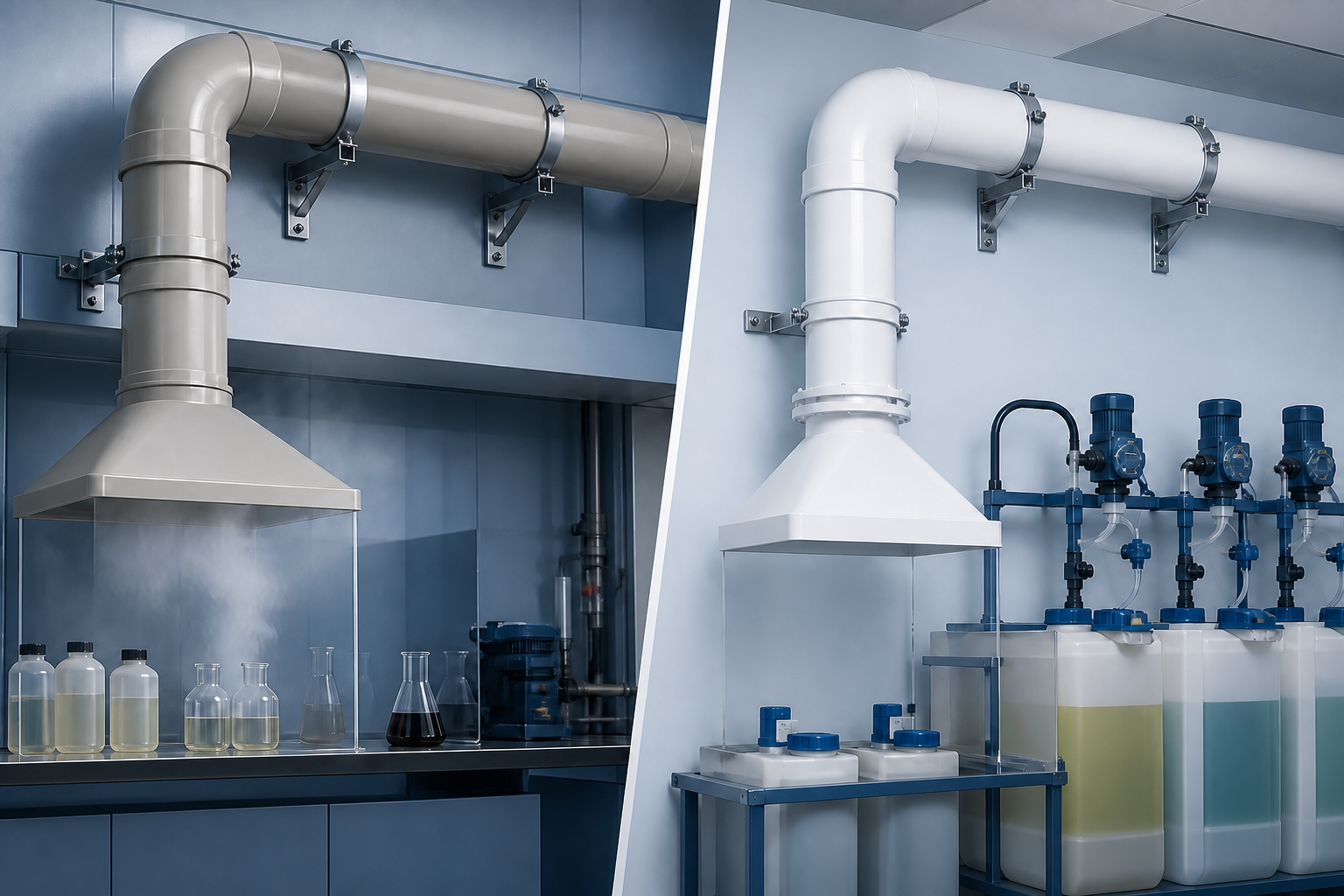
The points behind the table. Polypropylene resists chromic acid, concentrated nitric acid, and sulfuric acid above 70 %, a set of media that degrades PVC through oxidative attack (Ready Plastics comparison). Rigid PVC, in turn, has outstanding resistance to chlorine gas, hydrochloric acid, sodium hypochlorite, and chlorinated solvents — exactly the media that water-treatment dosing rooms and chlorine-handling plants test first, and the area where PP is only moderate. Charlotte Pipe’s technical team adds the necessary boundary: polypropylene can degrade with long-term exposure to oxidizing chemicals such as hydrogen peroxide or sodium hypochlorite (Charlotte Pipe: evaluating chemical resistance). That sentence matters because it prevents the common overclaim that PP is simply “the chemical pipe.”
The joint between claims and reality
No thermoplastic survives every chemical. Chemical resistance changes with temperature — resistance at 20 °C is not resistance at 60 °C — so the working discipline is to check the specific medium at the actual operating temperature (industry references such as PPI TR-19 compile these tables). A shortlist exercise: take the plant’s chemical list, sort by family, and score PP and PVC against each family. In most fume-exhaust and corrosion-service specifications, the family sort alone decides the material; only when both survive does the comparison move to mechanics and cost.
Decision point for chemical media
Select PP when the list contains oxidizing acids at meaningful concentration, or when the exhaust carries mixed aggressive vapors with no chlorine-heavy load. Choose PVC when chlorine, hypochlorite, chlorinated solvents, or HCl dominate the duty, or when the pipe must sit in a chlorinated water-treatment environment. When aromatics or halogenated solvents are present, neither material is valid — stop and look at fluoropolymers or another family before proceeding.
—
Mechanical strength: PVC is stiffer, PP is tougher and lighter
PVC carries roughly twice the stiffness of PP; PP carries about 35 % less weight and better room-temperature impact. Both facts matter, but in different parts of the system: stiffness decides how thin a wall can self-support under negative pressure, while weight and toughness decide how easy the run is to handle, hang, and keep intact.
The mechanics table
| Property | PP pipe | PVC pipe |
|---|---|---|
| Density | 0.90 g/cm³ | 1.38–1.40 g/cm³ (rigid) |
| Flexural modulus | 170,000–220,000 psi | 400,000–450,000 psi |
| Tensile strength | 25–40 MPa | 34–62 MPa (rigid) |
| Stiffness implication | thicker walls needed for equal rigidity | thin walls self-support under suction |
| Impact at room temperature | better relative to PVC | brittle relative to PP; handle carefully |
| Impact at low temperature | drops below 0 °C (GF guidance) | drops near 0 °C; no specified minimum (Vinidex) |
| Weight per meter | lighter — easier handling and hanging | heavier — more structural load on supports |
Rigidity is the mechanical argument for PVC. Its flexural modulus of 400,000–450,000 psi is roughly double PP’s 170,000–220,000 psi, which is why PVC duct and pipe can hold shape under negative pressure with thinner walls — a genuine structural advantage in fan-suction systems and long unsupported spans (Ready Plastics comparison). Tensile numbers follow the same pattern: rigid PVC at 34–62 MPa versus PP at 25–40 MPa, so PVC carries more load per unit of cross-section.
Lightness and toughness are the mechanical arguments for PP. At 0.90 g/cm³ versus 1.38–1.40 g/cm³, a PP run weighs about 35 % less, which shrinks support loads, rigging effort, and installation labor on long roof runs. PP also behaves better under room-temperature impact and repeated thermal cycling, which is why fabricators use it for complex duct layouts that take bending, cutting, and welding on site.
Neither material should be treated as impact-proof. PVC has no specified minimum service temperature, but its impact resistance falls as temperature drops — around 0 °C installation needs extra care (Vinidex VX-TN-8C). PP is not as impact-resistant below 0 °C either (GF recommends ABS or PE for cold applications). In service, both need padded supports, no point loading at brackets, and protection from forklift-adjacent zones.
Decision point for mechanics
Select PVC when the design leans on self-supporting spans, negative pressure, or thin-wall rigidity. Choose PP when weight, handling, or impact resistance at working temperature drives the spec, or when the run needs complex field fabrication where welding PP is faster than cementing many fittings.
—
Joints and installation: solvent cement vs welding
PVC is joined with solvent cement; PP is joined with heat — and the two methods are not interchangeable. The joint family drives install speed, leak risk, and chemical resistance at the connection, so it belongs in the material decision rather than after it.
The joining table
| Aspect | PVC pipe | PP pipe |
|---|---|---|
| Standard method | Solvent cement (ASTM D2855 practice, ASTM D2564 cement) | Heat welding: socket/butt fusion (ASTM D2657) or hot-gas welding (DVS 2207-3) |
| Large duct work | Hot-air weld with PVC rod above 18 in | Hot-gas weld with PP rod — the standard method |
| Joint character | Chemical weld of parts; relies on surface prep and cure time | Homogeneous fusion — no adhesive layer to degrade |
| Crew skill | Fast for standard straight runs; quality depends on fit-up and cure | Needs trained welder; slower but repeatable |
| Joint efficiency (proper process) | 80–90 % | 80–90 % |
| Can PP and PVC join? | No — fundamentally different polymers; solvent for PVC does not weld PP | No — the two materials never mix in one joint |
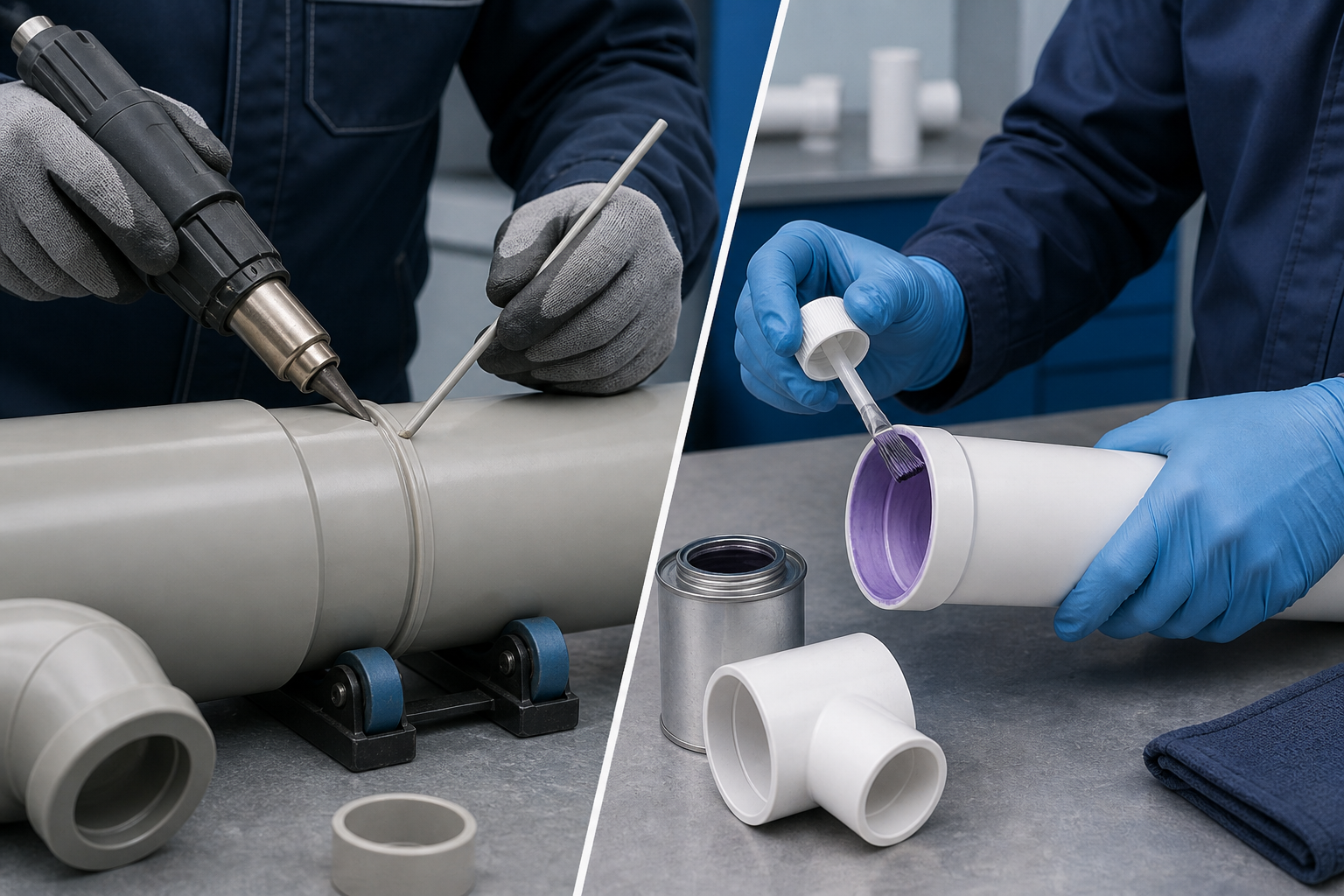
Solvent cementing is genuinely fast on standard straight runs: apply primer and cement, insert, and hold for the specified cure time (ASTM D2855). That speed is why PVC dominates plumbing and dry utility duct. The trade-off is that every cemented joint is a chemical system of its own — surface preparation, fit-up gap, and cure time all decide tightness, and the joint area is the first place to audit in chemical service.
Heat welding is the method for PP: socket fusion heats both parts and presses them together while molten, or hot-gas welding melts a PP rod into the seam. The result is a homogeneous connection without an adhesive layer — which matters in corrosive fume duty, because there is no cement line for media to attack. The cost is process discipline: welding needs trained hands and controlled temperatures, which is why PP fabrication is a shop or experienced-contractor activity rather than a two-person onsite routine. The extrusion-to-welding production sequence for PP duct is covered in how PP plastic duct is made, including the welding parameters that keep joints consistent.
There is also a size rule for PVC duct that surprises many buyers: above 18 in, PVC duct sections are joined by hot-air welding with PVC rod rather than solvent cement, because large-diameter cement joints are hard to execute reliably (U.S. Plastic Corp. guidance). So “PVC = glue, PP = weld” is true for typical pipe sizes, but large PVC duct migrates toward the same hot-air welding family as PP duct.
Finally, never attempt to mix them. Solvent cement made for PVC does not weld polypropylene, and no reliable adhesive joins the two polymers. A PVC-to-PP transition requires a mechanical adapter or a flanged connection designed for the purpose — a detail worth specifying before fabrication, not discovering on site.
Decision point for joints and installation
Choose PVC when the project rewards fast, low-skill jointing on standard straight runs and the media is friendly to cement joints. Select PP when the run is custom-fabricated, corrosive-duty, or large-diameter duct where welded homogeneous joints protect the system’s weakest points. If the specification must cross from one material to the other, plan flanged or mechanical transitions explicitly.
—
Service life and total cost: what you can honestly promise
Neither material has a single “lifespan” number, because lifespan is a function of media, temperature, and joint integrity — not of the polymer alone. Any article that quotes precise service years for either material is overpromising. What engineers can rely on is the design framework: thermoplastics piping is validated by long-term hydrostatic extrapolation (ISO 9080) toward a 50-year design basis, and real service life follows from correct material selection, correct installation, and maintenance.
The cost dimensions
| Dimension | PP pipe | PVC pipe |
|---|---|---|
| Material cost | Higher per pound | ~10–15 % lower per pound |
| Cost per volume | Near parity (PP is lighter) | Near parity (denser material) |
| Joint labor | Welder-dependent, slower on standard runs | Fast cement joints on standard runs |
| Complexity | Excellent for custom/fabricated layouts | Best for standard straight configurations |
| Replacement risk | Low when media matched | Low when media matched; joint audits in chemical service |
| Life basis | ISO 9080 long-term design framework | ISO 9080 / PVC design standards |
On the material ledger, PVC is roughly 10–15 % cheaper per pound, and because PVC is denser, equal-volume parts land at near cost parity (Ready Plastics comparison). So the “PVC is dramatically cheaper” story is mostly true at the weighing scale and mostly false at the installed-system scale. Installation swings the ledger harder than material price: cementing standard PVC runs is fast, which favors PVC on simple jobs; welding custom PP layouts favors PP on complex or corrosive jobs where fewer joints and homogeneous welds cut risk.
The honest service-life statement is the discipline of this guide. Both materials, correctly selected and installed, serve industrial systems for decades — the industry validates long-term strength through ISO 9080 extrapolation toward a 50-year design basis, and both PP-R and PVC piping designs sit inside that framework (ISO 9080:2012). What actually ends service life is a mismatched chemical, an overheated run, a damaged joint, or mechanical abuse — not the material name on the spec sheet. In corrosive duct service the practical longevity question is therefore about the system’s weakest point: joints, welds, and supports, which is exactly where the joining method discussion above matters.
Decision point for lifetime cost
Choose PP when the duty is corrosive or hot enough that premature PVC failure would force early replacement — the replacement cost of a full run dwarfs any 10–15 % material saving. Select PVC when the service is cool, well-characterized, and standard-configuration, where fast cement joints and lower material cost compound into the cheaper system today and a defensible life tomorrow. Name the assumed service life in your own spec, audit joints periodically in chemical service, and price the system rather than the pound.
—
Fire performance: PVC self-extinguishes, PP is combustible
Rigid PVC carries a UL 94 V-0 self-extinguishing rating; polypropylene is combustible at UL 94 HB. In a material comparison this axis rarely decides an outdoor or process-system specification, but it can decide roofed, concealed, or plenum-type runs where local building and fire codes impose flame-spread requirements.
| Fire property | PP pipe | PVC pipe |
|---|---|---|
| UL 94 rating | HB (combustible) | V-0 (self-extinguishing) |
| Flame behavior | Burns when ignited; retards only if formulated | Self-extinguishes when the ignition source is removed |
| Code implication | May need fire-retardant grades or containment for concealed runs | Often accepted for duct/plenum duty as-is |
| Relevant topic | Full PP flame-retardant grades discussion | — |
The practical read: for concealed ductwork, above-ceiling runs, or applications governed by flame-spread code, PVC’s V-0 self-extinguishing character is a real compliance advantage, while PP normally enters those applications as a flame-retardant (FR) grade or with requested documentation. The same UL 94 vocabulary applies to both materials in this article’s ecosystem — the separate guide Plastic Flame Retardant Grades: V-0, V-1, V-2, HB Explained walks the rating ladder, the 30-second and vertical burn tests, and how FR-grade PP behaves versus PVC. When fire code is in play, read that guide and the local code together; a rating on a datasheet is not the same as a building-code acceptance letter.
Decision point for fire performance
Select PVC when the run is concealed or code-bound and V-0 self-extinguishing behavior resolves compliance without treatment. Choose PP when the process demands it otherwise, then follow up with an FR grade where code applies — and check the flame-retardant grades guide for the honest rating boundaries before promising a class.
—
Choose PP pipe when…
PP wins when temperature, media, or fabrication complexity outruns PVC’s envelope. If your duty ticks one of the boxes below, stop comparing and start specifying PP:
- Continuous or sustained medium temperature above 60 °C (PP design ceiling 80 °C pressure-rated, ~100 °C low-stress).
- Oxidizing acids — chromic, nitric, sulfuric above 70 % — at meaningful concentration.
- Corrosive fume exhaust from chemical plants, electroplating and pickling lines, laboratory fume hoods, and waste-gas treatment scrubbers.
- Long roof runs where PP’s ~35 % lighter weight cuts support and rigging cost.
- Custom layouts — tees, wye branches, transitions, rectangular-to-round — where field welding beats cementing dozens of fittings.
- Systems where homogeneous welded joints remove the adhesive line as the first chemical failure point.
- Projects planning extended service in aggressive media, where early PVC replacement would cost more than the material differential.
| PP quick-fit checklist | Answer |
|---|---|
| Continuous temperature above 60 °C? | PP |
| Oxidizing acids (chromic, nitric, >70 % H2SO4)? | PP |
| Corrosive fume exhaust / scrubber duty? | PP |
| Long runs where lighter weight cuts rigging? | PP |
| Custom welded layouts dominate? | PP |
| Chlorine-heavy media present? | Check PVC side first |
For those duties, the polypropylene duct family is the direct fit. The polypropylene PP air duct product page shows the dimensional range and configuration options, and the PP plastic exhaust duct range covers fume- and scrubber-connected runs. For the wider material picture — PP versus PVC and metal as full duct systems — the duct material comparison hub puts this pipe-level comparison in context, what is PP air duct gives the system-level introduction, and the ventilation duct materials guide maps the full material zoo for engineers comparing beyond two polymers.
Decision point for the PP path
Choose PP pipe when the medium list, the temperature sheet, or the layout calls any of the boxes above — then specify the system with welded PP, not cement. If the duty is borderline (cool media, near-60 °C peaks, mild chemistry), run the numbers through the de-rating and chemistry tables in this guide before committing; borderline choices should be decided on the five axes, not on habit.
Worked example: an electroplating exhaust run
A plating shop exhaust line carries chromic and sulfuric acid mist at a continuous 55 °C with peaks to 70 °C. Axis 1 (temperature) already answers: the PVC continuous ceiling is 60 °C and its pressure class collapses at the top of its range, so PVC is out before chemistry is consulted. Axis 2 confirms the direction — chromic acid sits in the oxidizing-acid quadrant, PP’s stronghold. Axes 3–5 then decide the details, not the material: PP welded duct with homogeneous joints (axis 4), sized for the light weight on the roof run (axis 3), and priced against the alternative of repeated PVC replacement in a 55–70 °C duty (axis 5). One scenario, five checks, one defensible material.
—
Choose PVC pipe when…
PVC wins when the duty is cool, well-characterized, dry, or chlorine-dominated — and when stiffness and installation speed matter more than temperature headroom. The boxes that point to PVC:
- Water-treatment dosing rooms, chlorine gas, hypochlorite, HCl, and chlorinated solvent service.
- Consistent cool media — ambient to about 60 °C peaks — where the de-rating table keeps full pressure headroom.
- Self-supporting spans and negative-pressure duct where PVC’s roughly 2× stiffness carries thin-wall rigidity.
- Standard straight configurations where fast solvent-cement joints minimize labor.
- Concealed or code-bound runs where V-0 self-extinguishing behavior (UL 94) resolves flame-spread compliance without treatment.
- Projects where the 10–15 % per-pound material saving genuinely influences budget and the service stays inside PVC’s envelope.
| PVC quick-fit checklist | Answer |
|---|---|
| Chlorine, hypochlorite, HCl, chlorinated solvents? | PVC |
| Cool media, ambient to 60 °C peaks? | PVC |
| Self-supporting spans / negative-pressure duct? | PVC |
| Standard straight runs with fast cement joints? | PVC |
| Concealed runs where V-0 helps code compliance? | PVC |
| Sustained >60 °C or oxidizing acids? | Not PVC — see PP |
The honest boundary deserves equal space. PVC fails early when asked to run hot (sustained >60 °C), handle oxidizing acids (chromic, nitric, sulfuric >70 %), or survive aromatic or halogenated solvents — and in those duties the cheapest pipe becomes the most expensive replacement. Rigid PVC is a strong, well-proven material; it fails only when specified outside its envelope, exactly as PP would fail inside chlorine-heavy or solvent-heavy duty. The engineering conversation is always “which envelope does this duty sit in,” never “which material is better.”
Decision point for the PVC path
Select PVC when the duty list sits inside its envelope — cool media, chlorine chemistry, standard runs, code-bound concealment — and the per-pound saving compounds with fast jointing. If any single condition breaches the envelope (temperature, oxidizing acid, aromatics), the system belongs to PP or another family, and re-running the five axes costs less than one premature replacement.
—
FAQ
Which is stronger, PP or PVC pipe?
It depends on the load. Rigid PVC carries higher tensile strength (34–62 MPa vs 25–40 MPa for PP) and roughly double the flexural modulus (400,000–450,000 psi vs 170,000–220,000 psi), so PVC wins stiffness and load per cross-section. PP wins weight (35 % lighter) and room-temperature impact. “Stronger” without loading conditions has no engineering meaning.
Can I glue PP pipe with PVC solvent cement?
No. PVC solvent cement is formulated for PVC (ASTM D2564) and does not weld polypropylene. PP is joined by heat — socket/butt fusion (ASTM D2657) or hot-gas welding (DVS 2207-3). Crossing from PVC to PP requires a mechanical or flanged adapter; never attempt a cement joint between them.
Should I use PP or PVC for hot exhaust?
PP, if the exhaust runs above 60 °C continuous. PVC’s continuous ceiling is 60 °C (pressure class ×0.20 at 140 °F), while PP pressure systems are rated to 80 °C with a material-level ceiling near 100 °C at low stress. Sustained >60 °C service is the classic PP application.
Is PVC pipe cheaper than PP?
At the scale: roughly 10–15 % cheaper per pound. Because PVC is denser, equal-volume parts land near cost parity. Installed cost is dominated by jointing (fast cement on standard PVC runs; welding on custom PP runs) and by failure risk — a premature replacement costs more than any 10–15 % material difference.
Which pipe lasts longer?
There is no honest single answer: service life is a function of media, temperature, joint integrity, and maintenance, validated by long-term extrapolation (ISO 9080) toward a 50-year design basis for both families. Correctly matched, both serve decades. Mismatched (hot duty for PVC, chlorine-heavy duty for PP) either fails early. Audit joints in chemical service either way.
What is the difference between PP, PPR, and PVC pipe?
PVC is polyvinyl chloride — rigid, stiff, solvent-cemented. PP (polypropylene) is a semi-crystalline polymer — lighter, better oxidizing-acid and temperature envelope, heat-welded. PPR (polypropylene random copolymer) is the plumbing-grade PP variant standardized by ISO 15874 for hot/cold water systems; it shares PP’s welding and temperature advantages but is a potable-water formulation, not a duct material. HDPE (polyethylene) sits nearby with better low-temperature impact but a lower temperature ceiling. For exhaust and chemical service, the practical contest is PP vs PVC; for hot water, PPR.
—
Conclusion: run your own five-axis check
This comparison gives you the decision method, not just the verdict: temperature envelope, chemical family, mechanical duty, joint method, and lifetime cost. Apply the tables to your medium list and operating conditions, and the right material names itself. If you are specifying PP ductwork for corrosive or warm fume service, the polypropylene PP air duct range and the exhaust duct range carry the dimensional and configuration details, and our team (contact, company background) supports spec review for borderline duties.